What Is A NHP Study
What is an NHP study?
An NHP study is a preclinical study that uses non-human primates (NHPs), most often cynomolgus (Macaca fascicularis) or rhesus (Macaca mulatta) macaques, to answer one defined biological or drug-development question. A protocol states which of these it will measure: disease-related endpoints, pharmacology, biomarkers, imaging, or selected safety-related responses.
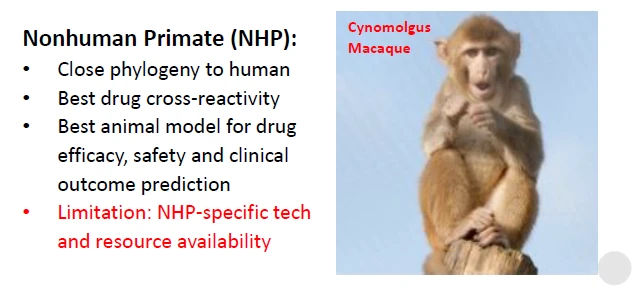
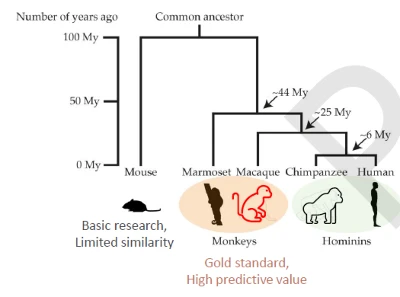
NHPs earn their place when a question turns on biology that in vitro systems and rodents represent poorly, such as target cross-reactivity, immune function, organ anatomy, or complex behavior. They are resource-intensive, and few programs need them by default. The decision to run an NHP study follows from a stated scientific rationale, a review of alternatives, and ethical approval before work starts.
Considering an NHP study? Share your therapeutic area, target or mechanism, modality, development stage, and the decision the study needs to inform. Prisys Biotech will discuss model fit, endpoints, and study scope. Discuss your study with Prisys.
At a glance
- What it answers: one defined development question, not a list of procedures.
- Species: cynomolgus (Macaca fascicularis) and rhesus (Macaca mulatta) macaques.
- Study types: disease model and efficacy, PK/PD and exposure-response, biomarker and target engagement, imaging and longitudinal, safety-related assessment.
- Endpoint families: clinical and behavioral readouts, laboratory biomarkers, PK/PD, MRI / CT / PET-CT / DSA / DEXA / ultrasound, electrophysiology, histopathology, and tissue-based analysis.
- At Prisys Biotech: NHP disease models across eight therapeutic areas, an AAALAC-accredited research center in Shanghai, and the PRISYS Translational Research Center (PTRC).
When is an NHP study appropriate?
Teams weigh an NHP study when the evidence they need is hard to obtain elsewhere. Five situations come up repeatedly. Each one points at a gap in the model system rather than a preference for primates.
- the target or drug cross-reacts poorly in commonly used laboratory species;
- the question needs integrated physiology, anatomy, immune response, or complex behavior;
- a delivery procedure, device, imaging method, or repeated sampling plan needs testing in a larger animal;
- the program needs longitudinal data on disease, exposure, biomarkers, or treatment response;
- the decision depends on linking pharmacology to functional, imaging, or tissue endpoints.
These are reasons to assess NHP suitability, not automatic indications to proceed. Model choice follows from the target, the modality, species relevance, the endpoint, and the alternatives available. NHP data do not guarantee a particular clinical outcome.
What questions can an NHP study answer?
A well-designed study starts from a decision question rather than a list of procedures. Typical examples: does the candidate engage its intended target, does exposure track with a pharmacodynamic response, does a disease-relevant endpoint move during treatment.
The protocol ties each objective to a measurable endpoint and states how the result feeds the next development decision. Endpoints span clinical observations, laboratory biomarkers, PK/PD, imaging, behavior, electrophysiology, histopathology, and tissue-based analyses.
Common types of NHP studies
Disease model and pharmacology studies
Disease model studies evaluate a candidate therapy in a selected NHP model. The model, induction method, treatment window, and endpoints follow from the indication and the therapeutic hypothesis. Prisys Biotech's portfolio covers eight therapeutic areas: CNS/Neurology, Immunology and Inflammation, Cardiometabolism, Nephrology, Respiratory disease, Bleeding and Clotting, Fibrosis, and Ophthalmology.
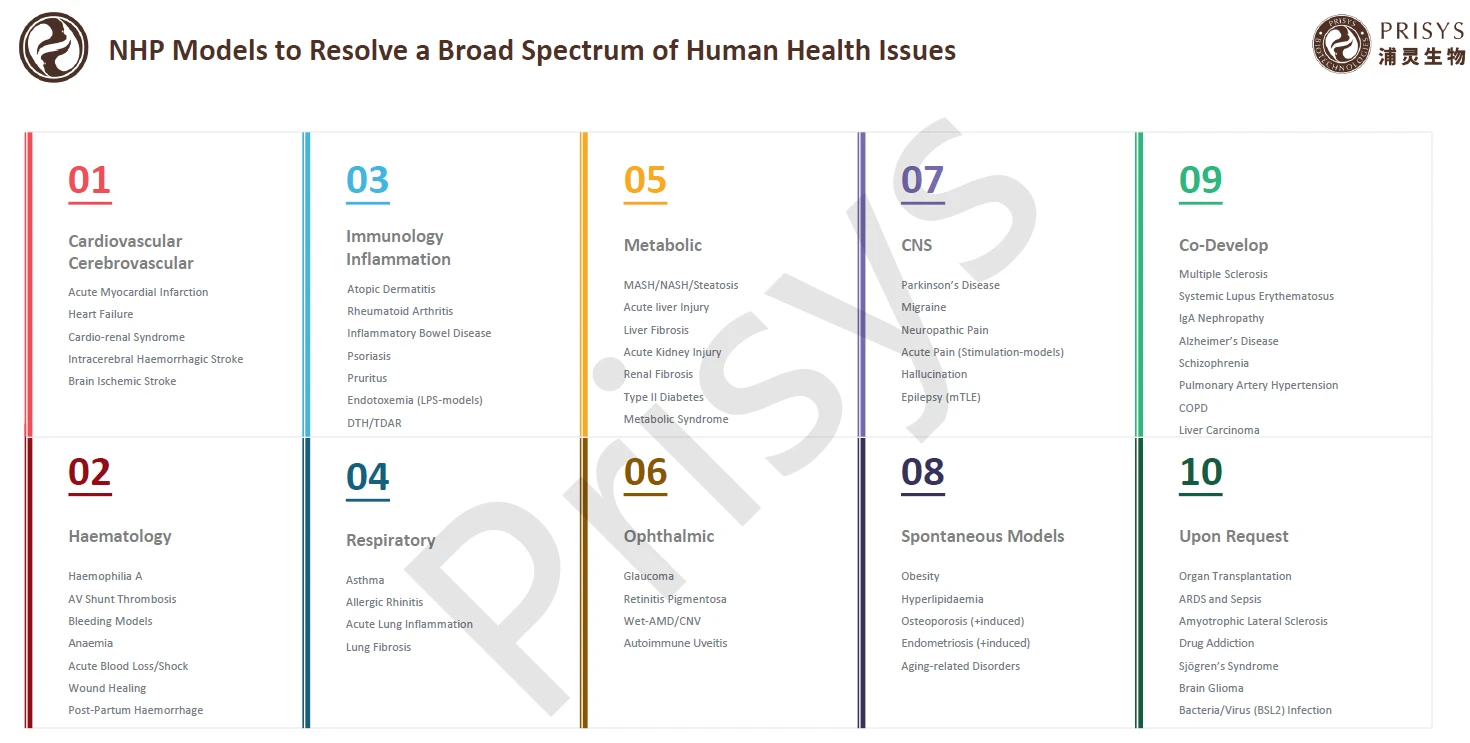
Browse the NHP disease model directory or the NHP pharmacology overview to identify a relevant research area. Model availability and development status are confirmed project by project.
PK/PD and exposure-response studies
PK studies track how drug concentration changes over time; PD studies record the biological response to treatment. When a protocol connects the two, the resulting exposure-response relationship informs dose selection and target-related effects.
Sampling matrices, time points, assays, and analysis requirements follow from the compound and the study question. Prisys Biotech develops and runs these methods end to end, from dose route and sampling schedule through bioanalysis and reporting.
Biomarker and target-engagement studies
Biomarker studies evaluate biological activity, target engagement, or pharmacodynamic response using blood, urine, CSF, tissue, imaging, or other protocol-defined measurements. Pick a biomarker for its relevance to the mechanism and the decision at hand; a change in one biomarker does not establish clinical benefit by itself.
Imaging and longitudinal studies
Clinical imaging covers MRI, CT, PET-CT, DSA, DEXA, and ultrasound, and characterizes anatomy, disease features, procedure placement, or change over time. A study rarely rests on imaging alone. Pairing it with clinical observations, biosampling, pathology, and functional readouts gives the program more than one evidence stream.
Prisys's clinical imaging platform documents each modality. For selected CNS programs, MRI-guided delivery and CED can be added.
Safety and tolerability assessments
Safety-related observations fit into a preclinical protocol when the development question calls for them. Prisys Biotech runs dose range finding, toxicokinetics (TK), and toxicology studies, and agrees the design, endpoints, and applicable quality framework in advance. A protocol with safety-related endpoints is not automatically a GLP toxicology study; the specific study and facility scope have to be confirmed as such.
How to plan an NHP study
A practical study plan addresses six questions:
- What decision will the study support? Define the development question, such as model fit, proof of concept, target engagement, exposure-response, or delivery feasibility.
- Which species and model fit the question? Review target cross-reactivity, disease biology, model status, and available alternatives.
- Which endpoints will answer the question? Select clinical, behavioral, laboratory, imaging, pathology, PK/PD, or other measures, and state how each will be interpreted.
- What procedures and sampling are required? Specify dosing route, monitoring, imaging, sample matrices, and time points at the level protocol development needs.
- What ethical, welfare, and biosafety reviews apply? Confirm approvals and study safeguards before execution.
- What will the sponsor decide next? Agree on analysis, reporting, and how findings will be used in the program.
Plan NHP studies to answer one defined question, and limit unnecessary procedures and burden. Where the measurements are compatible, integrate them into a single protocol: adding endpoints without an interpretation plan costs animals, time, and budget while adding no evidence to the decision.
NHP study services at Prisys Biotech
Prisys Biotech is a preclinical CRO focused on NHP research. Its Shanghai research center and the PRISYS Translational Research Center (PTRC) bring together disease models, imaging and surgical capability, laboratory services, and dedicated study teams. One team carries a project from model selection through to the final report.
A study typically combines:
- model selection or model development discussion;
- protocol design and endpoint planning;
- dosing, clinical examination, and longitudinal monitoring;
- imaging, including MRI, CT, PET-CT, DSA, DEXA, and ultrasound;
- PK/PD and biomarker sampling;
- AI-based behavior analysis ;
- selected MRI-guided intracranial procedures and CED; and
- data analysis, interpretation, and reporting.
Prisys Biotech holds AAALAC accreditation, works under IACUC oversight, and maintains biosafety capability. Study procedures and quality requirements are confirmed for each project.
Prisys study discussion process
Initial project discussions cover the research question, potential model and endpoints, protocol scope, and commercial proposal. Sponsor review and the applicable ethical and biosafety approvals come next; only then does the study move to execution, data collection, analysis, and reporting. Timelines and deliverables depend on the model, procedures, assays, and approvals required.
Information to include in an initial inquiry
A brief, non-confidential outline is enough to begin a feasibility discussion. Include:
- therapeutic area and development stage;
- target, mechanism, and modality, if shareable;
- the main decision the study should inform;
- candidate model or alternative models under consideration;
- essential endpoints, imaging, or sampling needs; and
- anticipated timing or other project constraints.
Do not send confidential sequences, compound structures, or complete proprietary protocols through an unsecured form. Those details belong in an appropriate confidential process.
Frequently asked questions
Q: What does NHP stand for?
A: NHP stands for non-human primate. The term separates monkeys and apes used in research from humans; in preclinical drug development it usually means cynomolgus or rhesus macaques.
Q: What is the difference between an NHP study and an NHP disease model study?
A: An NHP study is the overall research protocol. It may include PK/PD, safety-related assessments, imaging, biomarker work, or a disease model. An NHP disease model study uses a model with selected disease-related features to address a specific pharmacology or efficacy question.
Q: Why are NHPs used in preclinical drug development?
A: NHPs are useful when a research question depends on biological or physiological features that available alternatives do not represent well. Their relevance varies by target, drug modality, species, and model, so NHP use needs justification for each program.
Q: Which therapeutic areas can Prisys support?
A: Prisys's NHP research areas cover CNS/Neurology, Immunology and Inflammation, Cardiometabolism, Nephrology, Respiratory disease, Bleeding and Clotting, Fibrosis, and Ophthalmology. Confirm model availability and development status during project planning.
Q: Which drug modalities can be evaluated in an NHP study?
A: NHP studies support small molecules, antibodies and other biologics, oligonucleotides and other nucleic acid therapeutics, cell and gene therapies, and antibody-drug conjugates. The right model and study design follow from the mechanism, target, route of administration, and development stage.
Q: Can one NHP study combine efficacy, PK/PD, and imaging?
A: Yes, when the objectives and protocol support an integrated design. PK/PD, disease-related endpoints, imaging, behavior, biomarkers, and pathology combine where scientifically appropriate. Each endpoint needs a defined role in the interpretation.
Q: How do I know whether my program needs an NHP study?
A: Start from the decision the study needs to support, then assess species relevance, target cross-reactivity, model fit, endpoint requirements, alternatives, and ethical considerations. Prisys can discuss feasibility from a brief, non-confidential project outline.
Q: Do NHP study results predict clinical outcomes?
A: No preclinical model can guarantee a clinical outcome. NHP studies provide evidence on selected biological, pharmacological, exposure, or functional questions. Interpretation depends on study design, model limitations, and the wider evidence package.
Start a study-fit discussion
If your development program has a defined question that may require NHP evidence, contact Prisys Biotech to discuss model suitability, endpoints, and study scope. A focused first discussion clarifies whether an NHP study is appropriate and what information a protocol proposal needs.
Contact Prisys Biotechnologies
Hot Tags: what is a nhp study, research, study, monkey, gene therapy, nucleotide PD pharmacology, AMD Nonhuman Primates Disease Model, RNA PD pharmacology, Prisys Nonhuman Primate Disease Models, NHP pharmacodynamics, Delayed type Hypersensitivity DTH Nonhuman Primates Disease Model
Previous
Type 1 Diabetes Mellitus ModelNext
No InformationYou Might Also Like


Send Inquiry