Pharmacokinetics (PK) describes the time course of drug absorption, distribution, metabolism, and excretion (ADME). Characterizing that behavior is foundational in clinical and preclinical development. For most standard compounds, PK parameters stay predictable inside the therapeutic range, a condition known as linear pharmacokinetics: systemic exposure parameters such as the maximum plasma concentration (Cmax) and the area under the concentration-time curve (AUC) increase in proportion to dose.
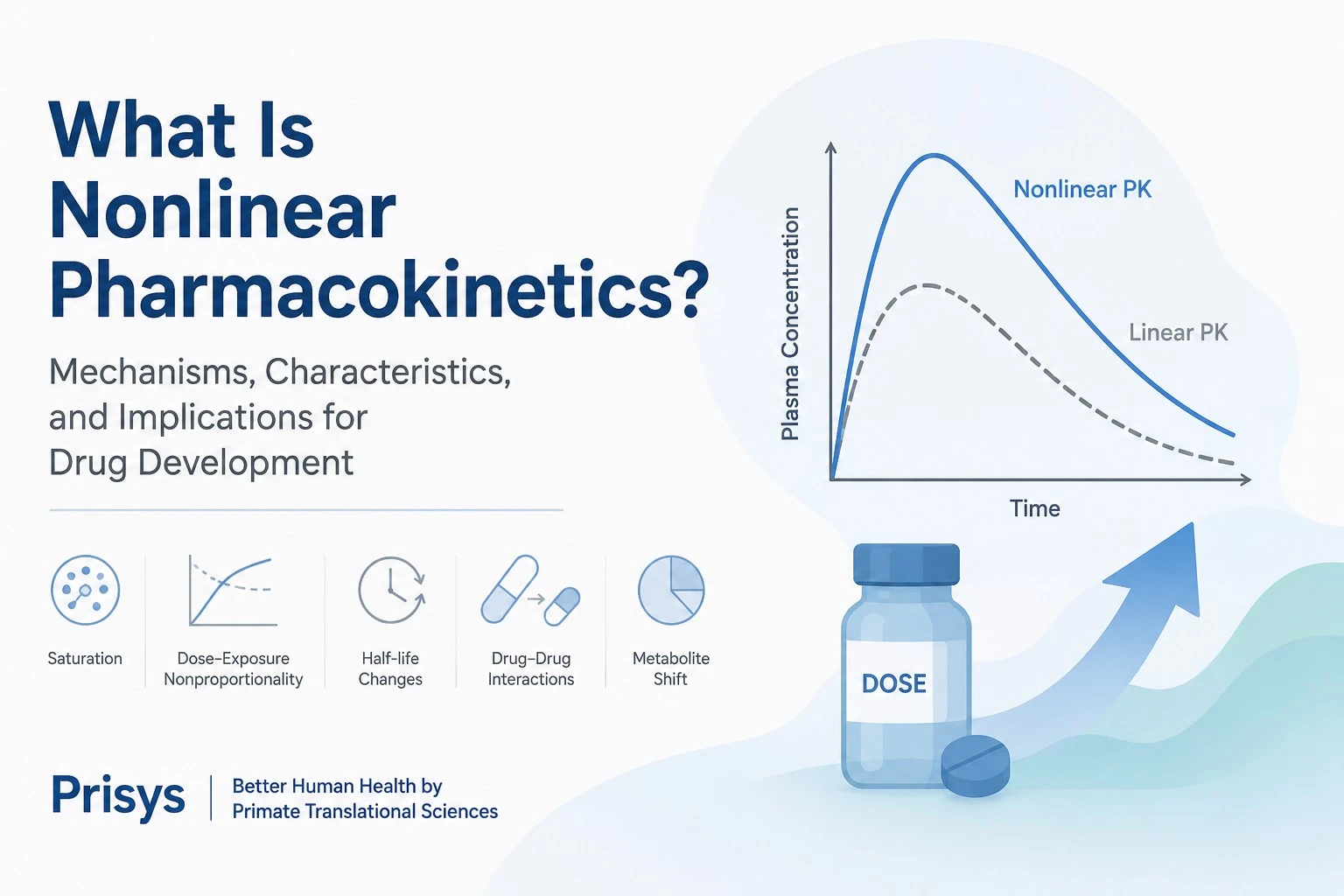
Many candidates do not follow that pattern. Exposure changes out of proportion to dose, and the behavior is termed nonlinear pharmacokinetics (nonlinear PK). Finding it early matters, because the alternatives are unexpected toxicity, a therapeutic hypothesis that fails for the wrong reason, and a human dose projection built on the wrong slope.
Linear Versus Nonlinear Pharmacokinetics
In linear PK, the primary ADME processes operate well below their capacity limits. The consequences are consistent:
- Cmax and AUC increase in direct proportion to the administered dose.
- Clearance (CL) and volume of distribution remain constant.
- Elimination half-life (t1/2) is dose-independent.
Nonlinear PK occurs when one or more biological processes become saturated, inhibited, or induced. Under those conditions, doubling the dose may produce a non-proportional change in exposure, in either direction: a rise in plasma concentration far larger than the dose step implies, or in some cases limited bioavailability.
The practical test is proportionality. Dose-normalized Cmax and AUC stay flat across the dose range under linear PK, and drift when the system is capacity-limited. A dose-normalized AUC that rises faster than dose points to saturable clearance or saturable binding; one that falls points to saturable absorption or auto-induction. Either direction makes a linear extrapolation unreliable, and the direction itself tells the formulation or modeling team where to look.
Core Mechanisms Driving Nonlinearity
Nonlinear PK typically arises when physiological pathways reach their capacity or are pharmacologically modulated.
1. Saturable Elimination (Michaelis-Menten Kinetics). Saturation of metabolic enzymes is the most common cause. When drug concentrations exceed enzyme capacity, elimination shifts from first-order (a constant fraction removed) to zero-order (a constant amount removed) kinetics. As the pathway approaches its maximum velocity (Vmax), clearance falls and the drug accumulates faster than the dose increment would suggest.
2. Saturable Absorption and Transporters. Nonlinearity can originate during absorption. For instance:
- Solubility-limited absorption: for low-solubility compounds, dissolution rate in the GI tract becomes the limiting factor, and bioavailability falls at higher doses.
- Transporter saturation: drugs dependent on uptake or efflux transporters, such as PEPT1 or P-gp, may show nonlinear absorption profiles once those transporters saturate.
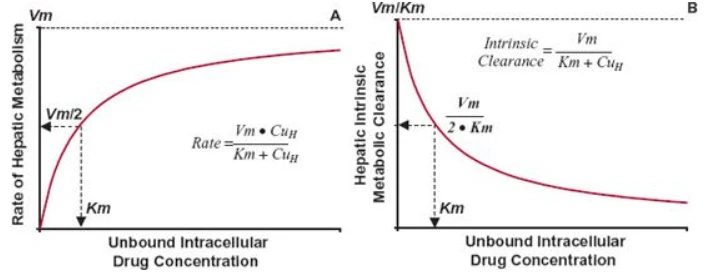
3. Protein Binding Saturation. For drugs with high plasma protein binding, saturation of binding sites can raise the free drug fraction (fu). Total concentration may still look well behaved while the unbound fraction, the pharmacologically active component, climbs. Clearance and distribution move with it, and the relationship between total dose and pharmacological effect becomes harder to read.
Binding saturation is easy to miss because the total concentration curve looks normal. Only the free fraction carries the pharmacology, so a study that reports total drug alone can understate exposure at the top of the dose range.
4. Enzyme Induction and Inhibition. Two time-dependent behaviors belong here.
- Auto-induction: certain drugs stimulate expression of the enzymes responsible for their own metabolism, so clearance rises and exposure falls over time.
- Auto-inhibition: others inhibit their own metabolic pathways, or those of co-administered drugs, and plasma concentrations rise with the associated toxicity risk.

Strategic Importance in Drug Discovery
Nonlinear PK creates problems that need specific analytical answers:
- Dose escalation: predicting exposure at higher doses becomes uncertain. Accurate modeling is required to define the therapeutic window, which is one reason escalation is designed alongside dose range finding (DRF) rather than after it.
- Metabolite profiles: as primary metabolic pathways saturate, secondary or minor pathways may become dominant, and unexpected or toxic metabolites can form.
- Drug-drug interactions (DDIs): when pathways sit near capacity, the potential for a clinically significant DDI is heightened, which makes rigorous interaction studies necessary.
Evaluating Nonlinearity: The Role of Translational Models
Identifying nonlinear behavior requires integrated studies across multiple dose levels. Standard models are often insufficient for complex therapeutic modalities such as biologics, antibody-drug conjugates (ADCs), and CNS-targeted therapies. These modalities frequently exhibit target-mediated drug disposition (TMDD) and receptor-saturated elimination pathways, and both distort the dose-exposure relationship in ways a single-dose study cannot reveal.
Work at Prisys Biotech follows four lines:
- Multi-dose PK profiling to assess dose proportionality across varying dose levels.
- Mechanistic ADME studies to isolate the source of nonlinearity, whether transport, metabolism, or protein binding.
- NHP Pharmacology: non-human primate systems that mirror human physiology, including transporter expression and metabolic profiles, and therefore return translational data rather than species-specific data.
- Integrated PK/PD/biomarker analysis, correlating systemic exposure with pharmacodynamics (PD) so that a dosing regimen can be judged on safety and efficacy together.
Conclusion
Nonlinear pharmacokinetics is a manageable facet of drug development once it has been characterized. Identifying saturation points, induction or inhibition potential, and mechanism-specific disposition early in the preclinical phase leaves room to change dose, schedule, or formulation before a protocol is fixed. At Prisys, disease models and pharmacokinetic evaluation run together, so potential nonlinearities are defined before clinical entry.
FAQ
Q: How is nonlinear PK identified in preclinical studies?
A:
Q: Are biologics more prone to nonlinear PK?
A:
Q: Does nonlinear PK always mean higher toxicity risk?
A:
Related Reading
- What Is Nonlinear Pharmacokinetics? Mechanisms And Translational PK Evaluation | Prisys Biotech
- Integration Of Pharmacokinetics And Pharmacodynamics in Drug Development
- Understanding Pharmacokinetics (PK): Key Parameters And Applications in Drug Development
- PK Biomarkers in Preclinical Drug Development