Evaluating Motor Function in Preclinical Parkinson's Disease Studies
Motor function is a central efficacy endpoint in preclinical Parkinson's disease (PD) research. Detecting a change in movement, however, is not the same as demonstrating a treatment effect. Behavioral scores vary with baseline motor impairment, task familiarity, spontaneous activity, observation conditions, and the stability of the disease model. In non-human primate (NHP) studies these sources of variation weigh more heavily, because longitudinal behavioral assessment usually involves several observers and several complementary tests.
A reliable motor function assessment strategy therefore establishes a reproducible baseline, quantifies distinct motor domains, minimizes observer-related variability, and defines in advance how behavioral change will be read alongside pharmacological and biological evidence.
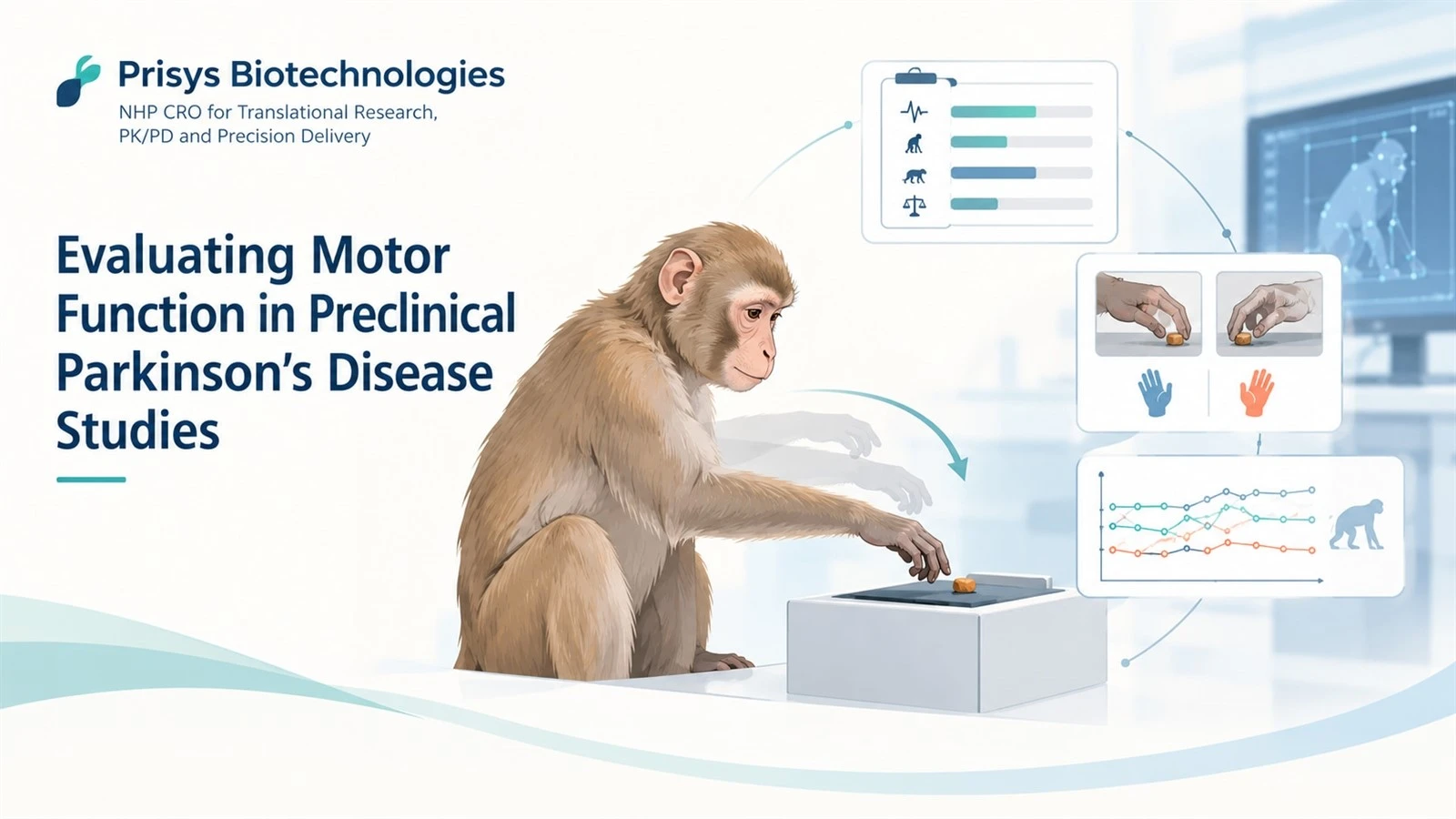
1. What Should Motor Function Assessment Measure in Parkinson's Disease Models?
Parkinsonian motor dysfunction is multidimensional. Bradykinesia, tremor, postural instability, impaired coordination, and reduced fine motor control develop to different degrees in individual animals. No single behavioral test captures all of these features or separates a meaningful therapeutic response from ordinary behavioral variability.
In preclinical studies, motor endpoints fall into three complementary categories.
Clinical-like motor ratings characterize the overall severity and pattern of parkinsonian signs. A structured rating scale, such as Kurlan's PD rating scale, records tremor, posture, gait, balance, and gross or fine motor impairment. The result is an integrated view of the motor phenotype, but its reliability depends on clearly defined scoring criteria and a consistent observation procedure.
Task-based motor assessments measure performance during a standardized activity. Food-grasping or food-retrieval tasks test the ability to reach for, grasp, and retrieve a reward. Fine motor tasks describe limb use, movement execution, and task completion in more detail. These tests produce specific quantitative endpoints: successful retrievals, task completion time, or performance by each hand.
Spontaneous movement and activity assessments capture movement outside a narrowly defined task. Video-based behavioral analysis or activity monitoring records locomotor activity, movement patterns, and shifts in the distribution of behavior over time. These measurements complement clinical ratings and task-based endpoints, although increased activity alone does not establish an improvement in parkinsonian motor function.
Published reviews of NHP Parkinson's disease models reach the same conclusion [1,2]: several clinically relevant outcome measures are needed, and the assessment strategy has to match the scientific question.
2. Selecting the Right Motor Endpoints for the Study Objective
Endpoint selection starts from the intended pharmacological or biological effect, not from the availability of a particular test.
For a symptomatic treatment intended to improve bradykinesia or overall motor disability, a structured motor rating is often the appropriate primary endpoint, supported by quantitative task performance. For a therapy intended to restore fine motor function, hand-specific reaching or food-grasping performance gives a more sensitive measure of the targeted deficit. For interventions expected to affect motor coordination or postural control, dedicated balance and gait assessments are often necessary.
|
Assessment method
|
Main information obtained
|
Important interpretive consideration
|
|
Kurlan's PD rating scale
|
Overall severity and distribution of parkinsonian motor signs
|
Requires standardized scoring and observer training
|
|
Food-grasping or food-retrieval task
|
Goal-directed movement, grasping and task performance
|
Motivation, training and reward engagement can affect results
|
|
Brinkman board test
|
Hand preference and fine motor performance
|
Hand dominance and side-specific baseline differences must be considered
|
|
Muscle strength grading
|
Gross assessment of muscle strength
|
Strength is not equivalent to bradykinesia or overall motor function
|
|
Apomorphine-induced rotation
|
Pharmacologically evoked rotational behavior in suitable unilateral-lesion paradigms
|
Direction and magnitude of rotation depend on the model and drug response
|
|
Video-based behavioral analysis
|
Movement patterns and longitudinal behavioral changes
|
Recording conditions and algorithm performance require appropriate control
|
These methods are complementary rather than interchangeable. A change in rotational behavior after apomorphine administration, for example, should not automatically be read as an improvement in spontaneous motor function. Increased food retrieval may instead reflect better motivation or task engagement than a direct gain in fine motor control.
Work in primate Parkinson's disease models separates goal-directed movement from abnormal or non-goal-directed motor activity when pharmacological responses are evaluated [2,3].
A practical approach defines one primary motor endpoint aligned with the study hypothesis and uses secondary endpoints to characterize the nature, consistency, and functional relevance of the observed effect.
3. Establishing Baseline Motor Function Before Treatment
Baseline characterization matters more in NHP studies because motor performance differs between animals before disease induction or treatment.
Baseline variation comes from age, spontaneous hand preference, prior task experience, individual activity levels, and the severity or laterality of model-associated motor impairment. In unilateral lesion models, the difference between the ipsilateral and contralateral limbs is informative, but it has to be read against each animal's pre-existing motor asymmetry.
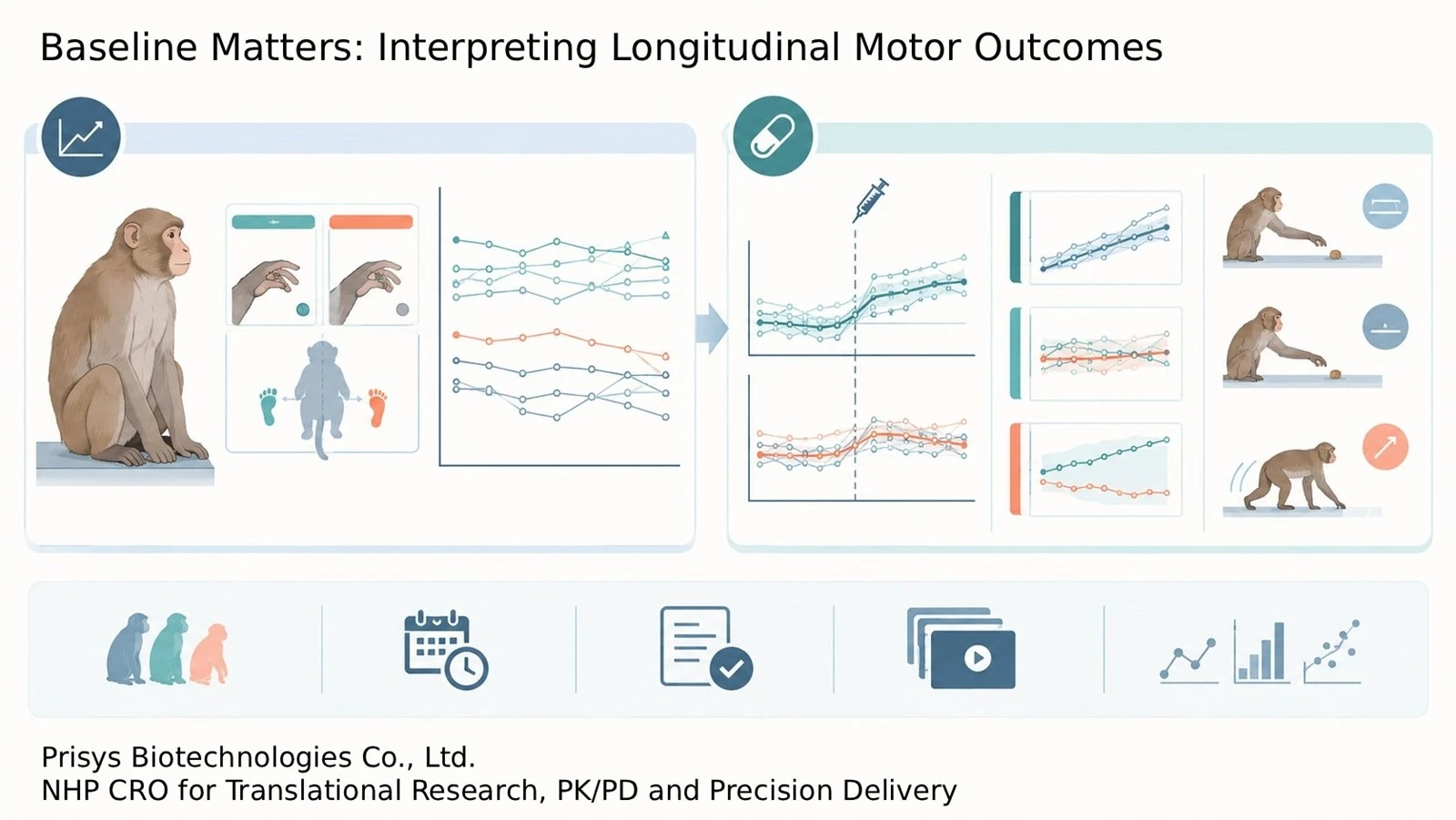
A baseline assessment should include repeated observations rather than a single measurement. Repeated measurements characterize normal within-animal variability and identify unstable performance before treatment allocation.
Where task-based endpoints are used, animals should be familiar with the task before the formal baseline period. Training should be standardized, and the criteria for a valid trial, a successful response, and an incomplete or unscorable trial should be defined in advance.
Baseline assessment should also establish whether each selected endpoint has adequate measurement range. A severely impaired animal may be unable to perform a task at all, which creates a floor effect. An animal with nearly normal performance has little room for measurable improvement, which creates a ceiling effect.
When baseline differences remain after screening, randomization and statistical analysis should account for the variables most relevant to the study hypothesis: baseline motor score, lesion side, disease severity, or task performance, depending on the design. The method should be specified before unblinding and should reflect the repeated-measures structure of the data.
In small NHP studies, individual trajectories deserve particular attention. Group means obscure substantial differences in disease severity or response patterns when the number of animals is limited.
4. Improving Observer Consistency and Behavioral Data Quality
Observer-dependent variability is a recognized challenge in rating motor behavior. Even with the same scale, different observers interpret the severity of tremor, bradykinesia, posture, or spontaneous movement differently, and the same observer can drift in how the criteria are applied across sessions.
Analyses of MPTP-treated primates make the case for standardized behavioral evaluation, including blinded assessment and reviewable video recordings [2,3].
Several measures improve consistency.
Standardize operational definitions. Each score needs an explicit behavioral definition and, where applicable, examples of the criteria that separate adjacent severity levels. Terms such as "mild impairment" or "reduced movement" should not be left to individual interpretation.
Train and calibrate observers. Before formal scoring, observers assess a common set of representative recordings, then review the differences and clarify the scoring rules.
Blind assessments where feasible. Observers should not know treatment allocation or the expected response when assigning behavioral scores. Blinding reduces the risk that expectations shape subjective ratings.
Standardize the observation environment. Time of day, observation duration, recording position, environmental conditions, handling procedures, and relevant pre-assessment activity should be controlled as far as practical. When pharmacological effects are time-dependent, the interval between dosing and behavioral testing should be prespecified.
Use video review and independent scoring. Recorded assessments can be reviewed, scored independently, and audited when discrepancies arise, and they help separate transient events from persistent change.
Quantify agreement. Observer consistency should be evaluated with a measure of agreement or reliability suited to the endpoint and data type. Ordinal rating scales usually call for weighted agreement statistics; continuous measures usually call for intraclass correlation or another suitable method. Reliability metrics should be read alongside the magnitude and pattern of disagreement, not as a substitute for sound scoring procedures.
Automated or AI-assisted behavioral analysis reduces some forms of manual scoring variability and makes systematic longitudinal measurement easier. Automation does not remove the need for validation: tracking accuracy, missing observations, changes in camera conditions, and the relationship between extracted features and clinically relevant motor behavior all need attention.
5. Interpreting Treatment Effects Against Model Variability
A treatment-associated change in a motor endpoint is not by itself evidence of therapeutic efficacy. Interpretation depends on the magnitude, consistency, timing, and specificity of the response.
First, the direction of change has to fit the endpoint. A lower parkinsonian rating score indicates improvement when the scale codes higher scores as greater disability. Increased locomotor activity or a change in rotation count does not, without an understanding of the underlying behavior and the pharmacological mechanism.
Second, the response has to be read against the expected variability of the model. Work on MPTP-treated macaques shows that disease severity and symptom stability vary with individual responses to model induction [3]. An apparent treatment effect is hard to interpret if motor impairment has not stabilized before treatment begins.
Third, temporal patterns matter. A rapid improvement after dosing is consistent with a symptomatic effect; a sustained change across repeated assessments provides different evidence. Neither pattern alone establishes disease modification. Claims about neuroprotection or disease modification need additional evidence matched to the mechanism and study design.
Fourth, the findings have to be examined across complementary endpoints. If a rating scale improves while task performance stays flat, investigators should ask whether the discrepancy reflects sensitivity, task engagement, or the specific motor domain being measured. If locomotor activity rises without improvement in goal-directed movement, nonspecific activation or abnormal motor behavior warrants consideration.
Finally, missing data and incomplete task performance need careful reading. An animal that fails to complete a task may be unable to perform the required movement, unwilling to engage, or affected by unrelated factors. Excluding such observations without prespecified rules biases the apparent treatment effect.
A defensible reading of efficacy therefore rests on the prespecified primary endpoint, the supporting behavioral measures, baseline severity, longitudinal stability, and the relevant pharmacological or biological evidence.
6. Aligning Motor Function Assessment With the Parkinson's Disease Model
Different PD models reproduce different aspects of the disease and suit different research questions. MPTP-based models are widely used to study parkinsonian motor dysfunction and symptomatic treatment responses. Other approaches, including targeted gene manipulation, address mechanisms tied to genetic risk or specific pathological processes. Onset, severity, stability, and treatment responsiveness differ between these models and should not be assumed equivalent [1,2].
Endpoint selection reflects the model's characteristics. A unilateral lesion model is particularly suitable for side-specific motor impairment, hand preference, or pharmacologically induced rotation. A model that produces broader motor dysfunction requires a fuller assessment of gait, balance, tremor, posture, and spontaneous activity.
The assessment schedule should follow the expected disease course. Early observations characterize symptom development; repeated measurements during a stable phase evaluate treatment effects. A stable baseline should rest on prespecified criteria, not on an assumption that symptoms have plateaued after a fixed interval.
Motor endpoints should be linked to the proposed mechanism of action. Dopaminergic symptomatic therapies, interventions intended to restore circuit function, and disease-modifying strategies need different combinations of behavioral and biological measurement. No single behavioral test establishes all of these effects.
7. Integrating Motor Endpoints in NHP Parkinson's Disease Studies at Prisys
Prisys' CNS research several motor assessment methods used in NHP Parkinson's disease studies: Kurlan's PD rating scale, food-grasping tasks, the Brinkman board test, muscle strength grading, and apomorphine-induced rotation analysis. The same materials place behavioral assessment alongside PET imaging and pathological endpoints in Parkinson's disease model development.
These methods support endpoint selection according to the model and study objective. A study focused on fine motor impairment might combine a hand-specific task with structured motor ratings; a study involving unilateral motor dysfunction might add side-specific performance and pharmacologically evoked rotation where scientifically appropriate.

Standardized Observation → Blinded Scoring → Independent Review → Reliability Assessment
Prisys' AAV-based research program includes Kurlan's rating scale, fine motor testing, balance assessment, and AI-based behavioral analysis. Study turns on the target motor domain, baseline characteristics, observation schedule, scoring procedures, and the relationship between behavioral outcomes and other measures of treatment response.
Conclusion
Reliable motor function evaluation in preclinical Parkinson's disease studies rests on four decisions: matching endpoints to the therapeutic hypothesis, characterizing baseline performance, controlling observer variability, and reading treatment-associated change against model-specific and within-animal variability.
Structured motor ratings combined with task-based assessments, and with longitudinal behavioral analysis where appropriate, describe motor function more completely than any single measure. Read alongside pharmacological and biological evidence, they support a more rigorous assessment of therapeutic response and reduce the risk of overreading behavioral change.
Frequently Asked Questions
Q: Which motor function tests are used in preclinical Parkinson's disease studies?
A: The choice depends on the study objective. Structured motor rating scales assess overall parkinsonian signs, food-grasping and fine motor tasks quantify goal-directed performance, and activity monitoring characterizes spontaneous movement. Complementary measures give a fuller picture than any one test.
Q: How can observer variability be reduced in NHP Parkinson's disease studies?
A: Use explicit scoring definitions, standardized observation conditions, observer training, blinded assessments, and reviewable video recordings where appropriate. Inter-rater agreement should be quantified with methods suited to the endpoint.
Q: Why is baseline motor function important when evaluating drug efficacy?
A: Baseline measurements identify pre-existing motor asymmetry, differences in disease severity, and floor or ceiling effects. Repeated baseline observations also separate treatment-associated change from ordinary within-animal variability.
Q: Does increased locomotor activity demonstrate an improvement in Parkinson's disease motor function?
A: Not necessarily. Increased activity may reflect improved movement, nonspecific stimulation, or abnormal motor behavior. The reading depends on the movement pattern, the study hypothesis, and supporting functional endpoints.
Q: How should motor endpoints be selected for NHP Parkinson's disease models?
A: Select endpoints according to the model phenotype, the intended therapeutic mechanism, and the primary study objective. Disease severity, laterality, task feasibility, measurement sensitivity, and the planned treatment and observation schedule all bear on the choice.
References
- Capitanio JP, Emborg ME. Nonhuman primate models of Parkinson's disease. ILAR Journal. 2007;48(4):339-355. https://doi.org/10.1093/ilar.48.4.339
- Bezard E, Przedborski S. Modeling Parkinson's disease in primates: the MPTP model. Cold Spring Harbor Perspectives in Medicine. 2011;2(3):a009308. https://doi.org/10.1101/cshperspect.a009308
- Modeling Parkinson's disease in monkeys for translational studies: a critical analysis. Experimental Neurology. 2014;256:133-143. https://doi.org/10.1016/j.expneurol.2013.09.014