A study published in Nature Neuroscience investigates how serotonin 5-HT2A receptor (5-HT2AR) signaling contributes to the sustained antidepressant-like effects of psychedelics, and how repeated low-dose administration may influence the behavioral responses associated with these compounds. Prisys Biotechnologies Co., Ltd. (Prisys) contributed to the non-human primate (NHP) component of the research: three-dimensional (3D) behavioral analysis, motor and cognitive assessments, and support for pharmacokinetic sampling in cynomolgus monkeys.
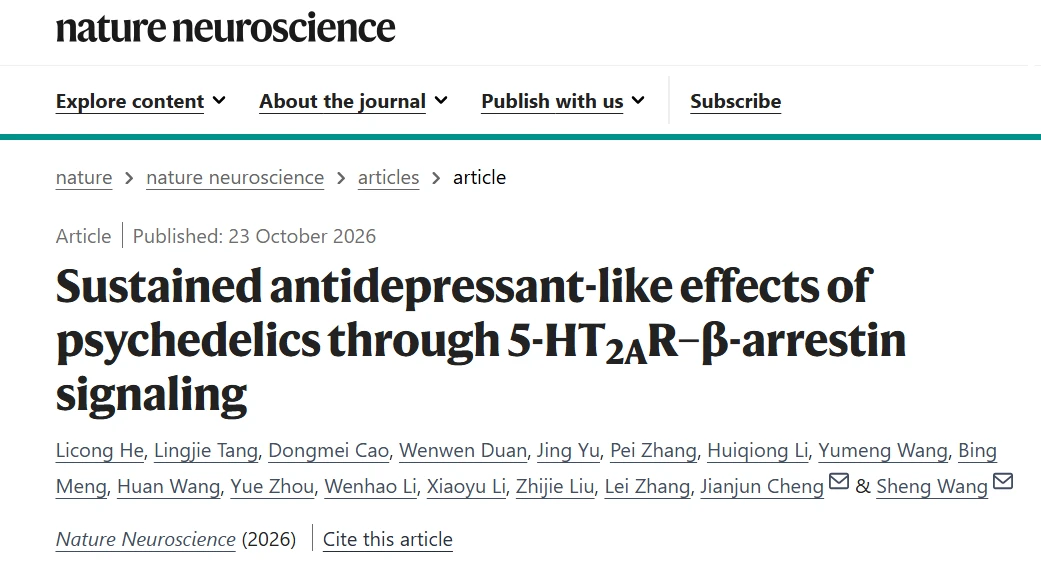
The paper, "Sustained antidepressant-like effects of psychedelics through 5-HT2AR–β-arrestin signaling," published on October 23, 2026, combines receptor pharmacology, structure-guided compound design, mouse behavioral studies, and functional assessments in cynomolgus monkeys. It examines the relationship between downstream receptor signaling, sustained pharmacological effects, and the behavioral responses associated with psychedelic compounds.
Read the original publication in Nature Neuroscience.
Investigating 5-HT2AR Signaling in Psychedelic Drug Development
The serotonin 5-HT2A receptor is a principal molecular target in psychedelic pharmacology. Its activation engages multiple downstream signaling pathways, including Gαq-mediated calcium signaling and β-arrestin recruitment. How these pathways map onto different pharmacological and behavioral effects is the question behind compound design that aims to keep therapeutic potential while limiting unwanted psychedelic-associated responses.
In this study, the researchers combined structure-guided compound design with receptor signaling assays and in vivo behavioral experiments. The results identified β-arrestin signaling as an important contributor to sustained antidepressant-like effects in mouse models. The team also examined the pharmacological properties of lysergic acid diethylamide (LSD), focusing on how its slow receptor dissociation kinetics influence the effects of repeated low-dose administration.
The proposed model distinguishes between signaling associated with peak drug exposure and responses that accumulate during repeated administration. Repeated low-dose LSD administration can progressively sustain 5-HT2AR engagement while limiting the high peak concentrations reached with a single larger dose. This pattern was linked to sustained β-arrestin signaling and comparatively limited Gαq-mediated calcium responses.
These findings provide a mechanistic framework for investigating psychedelic pharmacology and for developing compounds with different therapeutic and behavioral profiles. The proposed relationship between receptor engagement and downstream signaling should be interpreted against the experimental evidence, not as a direct demonstration of receptor occupancy in living animals.
The sustained antidepressant-like effects reported in this study were established in mouse models. The cynomolgus monkey experiments addressed a complementary question: how psychedelic compounds and dosing regimens affect spontaneous behavior, motor function, and cognitive task performance.
Prisys's Contribution to Cynomolgus Monkey Behavioral Research
Prisys provided the research setting for the NHP experiments and took part in the behavioral assessments and associated study procedures. These experiments formed part of the paper's wider effort to characterize drug-associated behavioral responses across experimental systems.
The NHP work combined spontaneous behavioral monitoring with task-based functional assessments. Plasma sampling supported pharmacokinetic characterization, which allowed drug exposure to be considered alongside the observed behavioral responses.
Behavioral change can reflect different aspects of CNS pharmacology, and no single endpoint captures the full response to a psychoactive compound. Recording spontaneous behavior alongside motor and cognitive performance gives complementary information about the nature and timing of drug-associated effects.
Quantifying Spontaneous Behavior Through 3D Reconstruction
Spontaneous behavioral analysis examined how psychedelic administration affected movement and posture without relying entirely on predefined task performance.

and Pharmacokinetic Sampling From 3D Behavior Analysis to Motor and Cognitive Assessments Source: Nature Neuroscience (2026)
Four synchronized cameras recorded each monkey from multiple viewpoints at 30 frames per second. After acclimation to the observation cage, video recordings were collected with no personnel or equipment left in the recording area. The analysis pipeline estimated the two-dimensional positions of 21 anatomical landmarks and reconstructed a three-dimensional skeletal representation over time.
The resulting time-series data were used to characterize behavioral patterns and quantify changes in movement and posture, which made it possible to examine the temporal distribution of different behaviors rather than an overall visual assessment or a single summary score.
After administration of LSD, the analysis identified a reduction in overall behavior during the first 30 minutes, together with changes in specific patterns such as head raising, head lowering, and sitting. Individual differences in behavioral recovery were also observed.
3D behavioral reconstruction helps characterize drug-associated responses in NHP studies. These results should be read within the limits of the dataset: the reported 3D behavioral pattern analysis involved a very small number of animals, and the absence of detectable changes in this experiment does not establish an overall safety profile for the compound.
Motor and Cognitive Testing Provide Complementary Endpoints
To complement spontaneous behavioral monitoring, the researchers evaluated motor performance with a beam-walking test and cognitive performance with a color-based delayed matching-to-sample (DMTS) task.
The beam-walking test assessed walking speed and the number of crossings completed during a three-minute session. After LSD administration, both measures decreased, indicating impaired performance under the experimental conditions. Psilocybin also impaired beam-walking performance, and MDL100907 pretreatment attenuated those effects.
The DMTS task assessed working-memory-related performance. The monkeys had to select a stimulus matching a previously presented color sample. The researchers recorded task completion, response accuracy, and reaction time, so that different aspects of task performance could be evaluated separately.
LSD reduced task completion and response accuracy while increasing reaction time. IHCH-8134 showed no apparent effect on these measures in the reported experiment.
Beam walking gave a defined measure of motor coordination and performance; DMTS assessed task execution, accuracy, and response speed under increasing memory demands. With the spontaneous behavioral analysis, these endpoints provided a broader characterization of the responses associated with compound administration.

Insights into the Sustained Antidepressant-like Effects of Psychedelics Source: Nature Neuroscience (2026)
Repeated Low-Dose LSD and Behavioral Responses
The study also examined whether repeated low-dose LSD administration could alter behavioral responses to a subsequent challenge dose.
Repeated low-dose administration did not produce detectable impairment in the reported beam-walking or food-tracking assessments. Following administrations LSD, pretreatment was associated with reduced behavioral sensitivity to a subsequent challenge in the beam-walking assessment in one female monkey. In male monkeys, the same pretreatment regimen attenuated challenge-associated impairment in the food-tracking test.
These observations suggest that dosing history and exposure patterns influence subsequent behavioral responses to psychedelics. Small cohorts and differences between the functional assays limit what can be concluded, and the authors note the need to validate the individual beam-walking observation in larger groups.
The NHP findings support further investigation of the relationship between pharmacokinetics, repeated dosing, and behavioral responses. They do not establish a dosing strategy for humans or demonstrate clinical antidepressant efficacy.
Implications for Preclinical CNS Research
For preclinical CNS research, the study shows what a combined readout can do. Receptor signaling assays characterize potential mechanisms of action, while in vivo behavioral endpoints show how those mechanisms relate to functional responses in an intact organism.
Within the NHP component, 3D behavioral analysis, motor testing, cognitive assessment, and pharmacokinetic sampling gave complementary perspectives on drug-associated responses. Continuous video analysis captured changes in spontaneous behavior, while task-based assessments measured specific aspects of motor and cognitive performance. Exposure data added context for interpreting the timing of these effects.

For CNS drug development, this integrated approach helps separate changes in spontaneous activity from impairments in defined functional tasks, and it supports a fuller characterization of candidate compounds. How far these endpoints can be interpreted depends on the study design, the sensitivity of each assay, the number of animals evaluated, and the consistency of findings across complementary measurements.
Prisys's participation in this collaborative research reflects its work in NHP behavioral assessment and preclinical pharmacology. The study is a published example of how quantitative behavioral analysis and functional testing in cynomolgus monkeys contribute to investigations of CNS drug effects alongside molecular and pharmacological research.
Reference
He, L., Tang, L., Cao, D. et al. Sustained antidepressant-like effects of psychedelics through 5-HT2AR–β-arrestin signaling. Nature Neuroscience (2026). https://doi.org/10.1038/s41593-026-02497-5