One of the central challenges in drug development is deciding whether a pharmacological effect seen in preclinical studies will also appear in humans. A candidate can show convincing efficacy in an animal model and still fail to produce the expected clinical response. Often the missing piece is a biological mechanism characterized well enough to predict its behavior in a second species.
The same molecule produces different responses across species, because target expression, receptor distribution, drug metabolism, tissue exposure, immune regulation and disease biology all differ. An improvement in an animal model therefore does not by itself establish that a mechanism will translate into clinical benefit.
Biomarkers give a way to work on that gap. By measuring the changes associated with drug exposure, target engagement, pathway modulation and disease response, a program can establish quantitative relationships between pharmacokinetics (PK) and pharmacodynamics (PD). Those relationships say how much exposure is needed, which biological mechanisms are affected, and whether the observed response relates to human disease.
In translational medicine the objective is a coherent framework: preclinical measurements inform clinical decisions, and clinical observations revise preclinical hypotheses. A list of candidate markers is not the deliverable.
1. What Makes a Biomarker Useful in Drug Development?
A biomarker is a measurable characteristic that indicates a biological process, a pathogenic process, or a response to an intervention. Molecular measurements, cellular characteristics, physiological parameters, imaging findings and objectively quantified behavioral changes all qualify.
Their value depends on the biological question they are meant to answer. Five categories recur in drug development.
Pharmacodynamic biomarkers show that a biological response has occurred after dosing: cytokine concentrations, phosphorylation of signaling proteins, gene expression, metabolic activity.
Target engagement biomarkers show that the drug has interacted with its intended molecular target. Receptor occupancy, target binding, and inhibition of target-associated signaling pathways are the usual readouts.
Predictive biomarkers identify patients more likely to respond to a particular treatment. PD-L1 expression and BRCA1/2 alterations are established examples in defined therapeutic settings.
Prognostic biomarkers describe the likely course of a disease independently of a particular treatment.
Safety biomarkers flag potential treatment-related toxicity or physiological disturbance.
The categories are not mutually exclusive. A single biomarker may carry different kinds of information depending on the study context.
A biomarker is also not a clinical endpoint or a surrogate endpoint by default. A reduction in a circulating inflammatory marker demonstrates biological activity; it does not establish that a patient will experience meaningful clinical improvement. Tying a biomarker change to a clinical outcome takes separate evidence.
That distinction shapes everything downstream. Measuring the change is the straightforward part. Interpreting what the change means for therapeutic efficacy is the harder one.
2. The Preclinical Foundation: Linking Drug Exposure to Biological Response
The most useful contribution of biomarkers during preclinical development is the connection they establish between drug exposure and pharmacological activity.
A conventional efficacy study shows that a treatment improves a disease-related endpoint. On its own it does not say whether the effect came from adequate target engagement, downstream pathway modulation, or an indirect biological response.
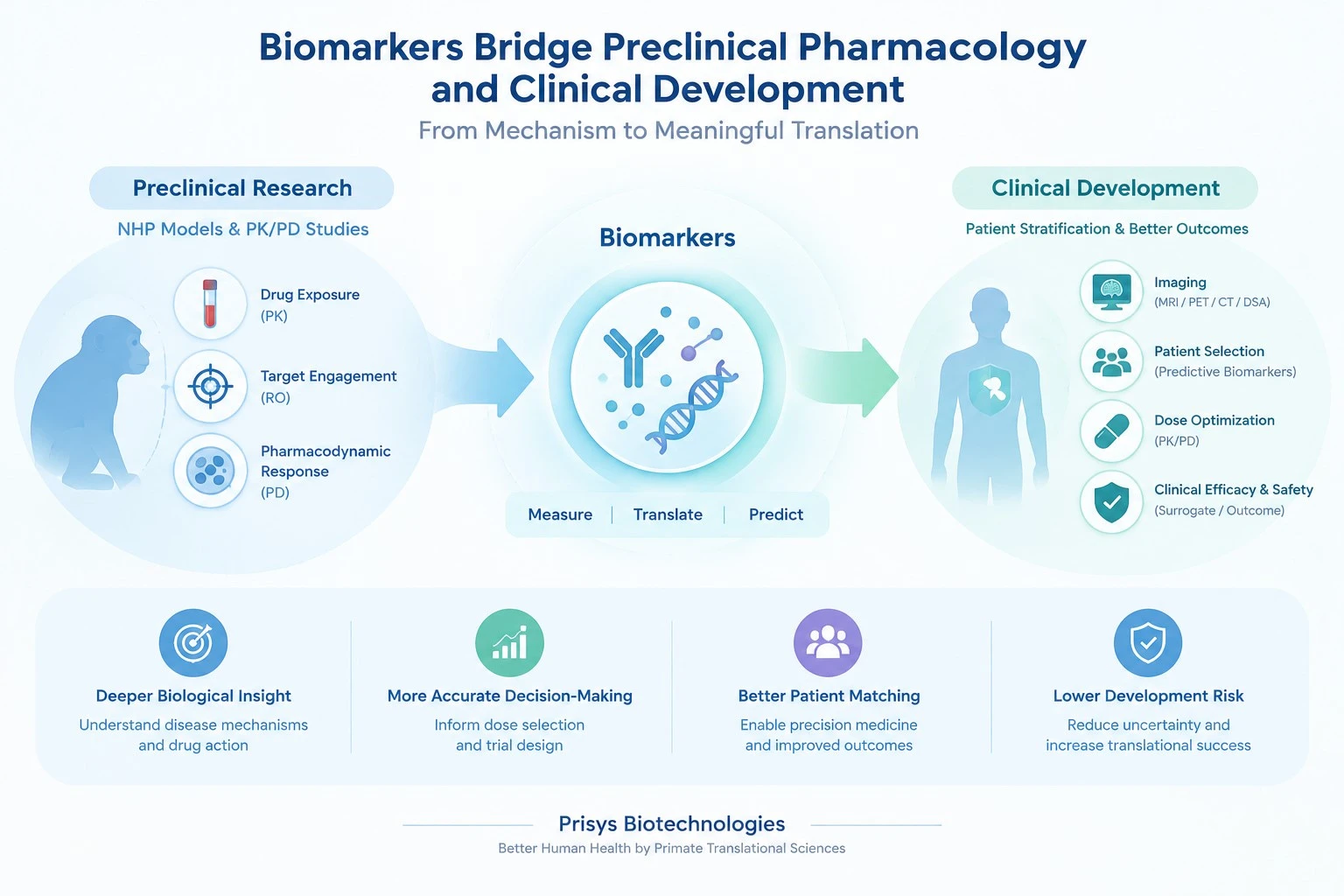
A more informative design establishes three connected relationships: drug exposure, target engagement, and pharmacodynamic response. Each answers a different question.
Drug exposure: How much drug reaches the relevant biological compartment?
Pharmacokinetic studies characterize drug absorption, distribution, metabolism and elimination. Plasma concentration is an important starting point, but it is a proxy for exposure at the site of action, and sometimes a poor one.
For drugs targeting the central nervous system, plasma exposure alone says little about the concentration available within brain tissue. Antibodies and other large biologics distribute differently from small molecules for reasons that sit outside plasma concentration.
Depending on the therapeutic mechanism, relevant measurements include total and unbound plasma concentrations, tissue concentrations, cerebrospinal fluid concentrations, or local drug distribution.
Target engagement: Does the drug interact with its intended target?
Target engagement links drug exposure to pharmacological activity.
For receptor-targeting antibodies, receptor occupancy (RO) estimates the proportion of available receptors bound by the drug. For kinase inhibitors, changes in target phosphorylation or in downstream signaling proteins provide evidence of pathway inhibition. Either way the measurement answers whether the administered dose produced sufficient biological interaction with the intended target.
Pharmacodynamic response: Does target engagement produce the expected biological effect?
Binding is not the same as response. A drug can occupy its target without producing sufficient downstream pathway modulation, particularly where compensatory mechanisms or redundant signaling pathways are involved.
PD biomarkers add that layer of evidence.
A kinase inhibitor, for example, reduces phosphorylation of its intended target, then shifts downstream signaling proteins, and finally moves a disease-related endpoint. Measuring all three levels separates direct target inhibition from broader biological effects.
Quantifying the exposure-response relationship
Once exposure and pharmacodynamic measurements are available, a model can characterize the relationship between them.
A common choice is the Emax model:
E(C) = E0 + (Emax x C) / (EC50 + C)
where E(C) is the observed pharmacological effect at concentration C, E0 the baseline effect, Emax the maximum achievable effect, and EC50 the concentration associated with 50% of that maximum.
More complex models add delayed responses, indirect response mechanisms, receptor turnover, or time-dependent changes in drug exposure.
The practical payoff is an exposure range rather than a single dose. Instead of taking the dose that produced the largest observed effect in an animal study, a program can identify the minimum exposure required for target engagement and the exposure associated with an adequate PD response. That is a more rational basis for setting doses and exposure targets in later clinical studies.
3. From Animal Studies to First-in-Human Dose Selection
Selecting the initial clinical dose is one of the clearest uses of preclinical PK/PD and biomarker data.
Nonclinical toxicity studies normally supply the safety anchor: a no-observed-adverse-effect level (NOAEL) converted to a human equivalent dose (HED), then divided by an appropriate safety factor.
For a highly potent or strongly biologically active compound, though, a starting dose derived only from toxicological observations can miss the pharmacology. Monoclonal antibodies, immune modulators and other targeted therapeutics often produce substantial biological effects at relatively low concentrations.
The minimum anticipated biological effect level (MABEL) covers that case. MABEL estimates the dose or exposure expected to produce a minimal biological effect in humans, drawing on the available pharmacological and nonclinical evidence, and it typically integrates:
- Target expression and binding characteristics.
- In vitro concentration-response data.
- Receptor occupancy and target engagement.
- Functional activity in relevant biological systems.
- PK and PD relationships across experimental models.
- Species differences in pharmacology and target biology.
MABEL does not replace NOAEL-based assessment in every development program. It adds a pharmacology-based consideration, and it matters most where excessive target activation or inhibition carries serious consequences.
The TGN1412 clinical trial remains the reference case for why toxicological findings alone can be insufficient for an immune-activating biologic. Healthy volunteers developed severe cytokine-release reactions despite preceding nonclinical testing. The episode turned on species-specific pharmacology, human-relevant biological activity, and the relationship between dose and immune activation, none of which the nonclinical package had resolved.
For a translational program, the lesson is that preclinical studies have to generate more than toxicity observations and efficacy outcomes. They also need to explain the mechanism well enough to anticipate the human response.
4. Early Clinical Development: Confirming That the Mechanism Works in Humans
Preclinical biomarker findings produce hypotheses. Clinical studies test whether they hold in humans.
During Phase I and early Phase II development, biomarkers are most useful for three jobs: confirming target engagement, locating biologically active exposure ranges, and describing the relationship between dose and pharmacological response.
Receptor occupancy is one example.
For drugs targeting cell-surface receptors, flow cytometry or another validated analytical method quantifies drug binding and receptor availability on the relevant circulating cell populations. Serial sampling shows whether occupancy rises with dose and whether it approaches saturation.
Peripheral blood has limits. Occupancy on circulating immune cells does not establish equivalent target engagement in solid tissues or in other disease-relevant compartments. Where the question is compartmental, tissue biopsies, cerebrospinal fluid measurements, imaging biomarkers or other compartment-specific assessments supply the missing evidence.
Downstream pathway measurements carry equal weight. BTK inhibitors are read through changes in BTK-associated signaling; MEK inhibitors through modulation of ERK phosphorylation.
Pairing target engagement with downstream PD answers two separate questions:
- Has the drug reached and interacted with its intended target?
- Has that interaction produced the expected biological response?
The pairing matters when interpreting clinical dose-response data. A dose that achieves near-maximal receptor occupancy need not produce the greatest clinical benefit, and further escalation can add treatment-related risk while adding little pharmacological activity.
Biomarker-guided dose selection therefore identifies a biologically active and clinically appropriate dose range, which is a different target from the maximum tolerated dose (MTD).
5. Biomarkers in Patient Selection and Clinical Efficacy Assessment
As development progresses, the role of biomarkers shifts from confirming pharmacological activity to identifying the patients most likely to benefit. That shift matters most for targeted therapies, immunotherapies, and treatments directed against molecularly defined disease subgroups.
The pembrolizumab program is a well-documented case.
Case Study: Pembrolizumab and PD-L1 as a Predictive Biomarker
Pembrolizumab is a monoclonal antibody targeting programmed cell death protein 1 (PD-1). Blocking the interaction between PD-1 and its ligands, PD-L1 among them, restores aspects of T-cell-mediated antitumor activity.
Early clinical development had two questions to answer at once: which dose could achieve sustained pharmacological activity, and which patients were more likely to respond.
Receptor occupancy studies supplied the pharmacological half. Clinical investigations demonstrated substantial PD-1 occupancy on circulating T cells across the evaluated dose range, with sustained target engagement, and those findings built the picture of how dose, exposure and occupancy relate.
Dose selection rested on more than occupancy. Clinical PK, pharmacodynamic findings, efficacy and safety data were weighed together. The early clinical program evaluated multiple dosing regimens, and 2 mg/kg every three weeks became an important dose in the initial development program.
Patient selection was the second question.
PD-L1 expression was investigated as a potential predictive biomarker. Immunohistochemistry quantified PD-L1 in tumor samples, and the results were tested against treatment response.
Subsequent clinical studies established the importance of PD-L1 expression in selecting patients for certain pembrolizumab indications. KEYNOTE-024 evaluated previously untreated advanced non-small cell lung cancer (NSCLC) with a PD-L1 tumor proportion score (TPS) of at least 50% and without sensitizing EGFR or ALK alterations, in a biomarker-enriched first-line treatment setting. Pembrolizumab produced improved clinical outcomes compared with platinum-based chemotherapy in that selected population.
The PD-L1 IHC 22C3 pharmDx assay was developed as a companion diagnostic for the relevant indications.
Two complementary applications sit inside that one program. Receptor occupancy supported the understanding of drug-target interaction and clinical pharmacology; tumor PD-L1 expression identified a patient population more likely to benefit. A marker of target engagement and a predictive marker answer different questions even when both belong to the same development program, which is why each is evaluated against its own intended clinical purpose.
6. Why Translational Biomarkers Must Be Evaluated Across Species
A biomarker that works in an animal model is not automatically suitable for clinical translation. Differences in molecular structure, target expression, immune regulation, metabolism and tissue distribution affect both the measurement itself and its biological interpretation.
Cross-species comparability therefore belongs in the design of preclinical research. Four aspects carry most of the risk.
Analytical comparability. Assays must be sufficiently specific and sensitive in the relevant species. Antibodies, primers, detection reagents and other analytical components can exhibit different performance characteristics in human and animal samples.
Biological relevance. A measurable change in an animal does not always represent the same biological process in humans. The question is whether the biomarker reflects a conserved mechanism or a species-specific response.
Tissue relevance. Biomarkers measured in peripheral blood often misstate biological activity in the target organ, which matters in CNS, oncology and tissue-specific inflammatory research.
Temporal relevance. Biomarker changes and clinical or functional responses can be offset in time, so the sampling schedule determines whether an exposure-response relationship is visible at all.
Non-human primate (NHP) models become useful where the pharmacological mechanism depends on conserved molecular targets, complex immune interactions, or physiological processes that conventional animal models represent poorly. For biologics and other species-sensitive therapeutics, NHP studies characterize target engagement, systemic exposure, immunological responses and pharmacodynamic effects in a physiologically relevant setting.
NHP studies do not eliminate interspecies differences. Their value depends on the relevance of the selected model, the pharmacological cross-reactivity of the candidate molecule, and the suitability of the biomarkers being measured.
A translational biomarker strategy is therefore built around the mechanism of action and the intended clinical application, rather than around the endpoints that happen to be convenient to measure.
7. Integrating Biomarkers into a Quantitative Development Strategy
Biomarkers deliver most when they sit inside an integrated development strategy rather than arriving as isolated measurements.
During preclinical development, PK measurements establish systemic exposure and, where relevant, tissue exposure. Target engagement assays determine whether the candidate interacts with its intended molecular target. PD biomarkers characterize downstream biological responses, and disease-related endpoints provide evidence of functional or pathological improvement.
PK/PD modeling and exposure-response analysis then consolidate those data into decisions on dose selection, dosing intervals, and the design of early clinical studies.
During clinical development, the same framework is refined with human PK, receptor occupancy, pathway activity, imaging findings and clinical outcomes.
Information does not flow in one direction. Clinical observations can show that a biomarker has limited predictive value, that a target is not sufficiently engaged in the relevant tissue, or that compensatory pathways influence treatment response. Those findings feed back into the interpretation of preclinical data and the design of subsequent studies.
A workable biomarker strategy rests on three requirements:
- Biological validity: does the biomarker reflect the intended biological mechanism?
- Analytical validity: can it be measured accurately and reproducibly?
- Clinical relevance: does the measured change provide meaningful information for drug development or patient outcomes?
A biomarker that satisfies one or two of these still has use in exploratory research; its ability to support clinical decisions remains limited.
Biomarker selection, assay development, sampling strategy and cross-species evaluation therefore belong in early study design, before efficacy results become available.
Implications for Preclinical Translational Research
Moving from preclinical pharmacology into clinical development requires more than evidence that a candidate drug produces an effect in an animal model. It requires a view of how drug exposure, target engagement, downstream biological activity and disease-related outcomes connect.
Integrated PK/PD studies and biomarker evaluation are how that view gets built.
In non-human primate research those assessments combine with longitudinal physiological measurements, clinical imaging, tissue sampling and functional endpoints inside a single experimental framework. An NHP CNS study, for instance, can integrate plasma and cerebrospinal fluid drug concentrations, imaging-based assessment, tissue-specific target engagement, and neurological or behavioral endpoints. The result is several layers of evidence instead of a single terminal measurement.
At Prisys Biotech, NHP pharmacology studies incorporate PK/PD evaluation, disease-related biomarker assessment, clinical imaging and functional endpoint analysis according to the objectives of the research program. The specific study design and analytical strategy are determined by the candidate drug, mechanism of action, and intended clinical application.
Treating biomarkers as decision inputs rather than as volume is the practical difference. Where biological activity can be quantified and interpreted consistently across experimental models and clinical studies, development decisions rest on evidence, and the distance between preclinical efficacy and human response becomes something a program can investigate directly.