Behavior is a functional endpoint in preclinical research, particularly in neuroscience, pain research and neurodegenerative disease. Locomotion, posture, limb coordination, spontaneous activity and specific behavioral patterns all shift with disease progression and with drug exposure.
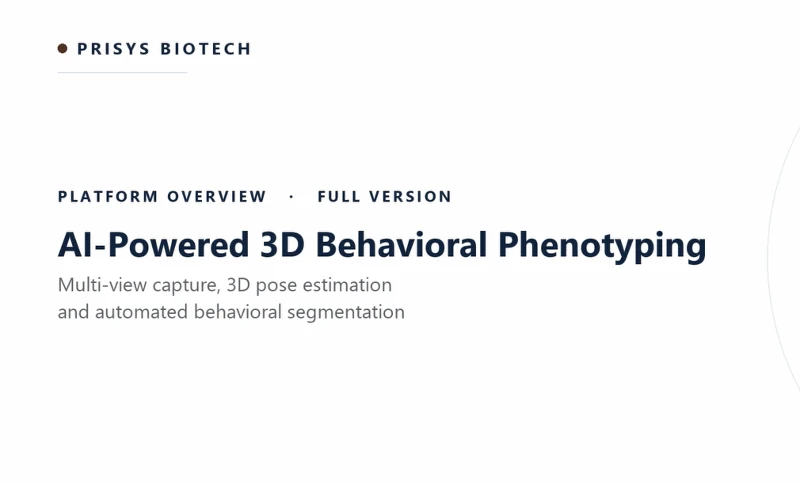
Central nervous system (CNS) drug development depends on those functional readouts. Behavioral assessment in non-human primates (NHPs) is nonetheless hard to run well. Traditional practice relies on direct observation, manual video review and experience-based scoring. These methods remain the backbone of many study designs, and they are slow, prone to inter-observer variability, and too coarse for subtle or short-duration events.
Advances in artificial intelligence (AI) and computer vision have opened a different route. Synchronized multi-view video acquisition, markerless 3D pose estimation and automated behavioral analysis now extract movement and posture from naturally occurring animal behavior.
For NHP studies, AI-powered 3D behavioral phenotyping adds a functional readout to conventional clinical observation, pharmacokinetic/pharmacodynamic (PK/PD) measurement, imaging and other pharmacological endpoints.
Quick Answer: What Is AI-Powered 3D Behavioral Phenotyping?
AI-powered 3D behavioral phenotyping uses synchronized multi-camera video and AI-based pose estimation to reconstruct animal movement in three-dimensional space. It quantifies movement kinematics, limb coordination, posture, gait and selected behavioral patterns without attaching physical tracking markers to the animal. In NHP research, the approach adds objective, longitudinal functional endpoints to preclinical drug evaluation.
Why Conventional Behavioral Assessment Has Limitations
Behavioral observation has long been used to evaluate neurological function, disease phenotypes and drug response in animal studies. The limitations appear once detailed and repeated measurements are required.
Manual behavioral scoring depends on predefined observation criteria and on the experience of trained researchers or veterinarians. Differences in observation frequency, scoring interpretation and individual judgment introduce variability between observers and across study time points.
Temporal resolution is the second constraint. An observation taken at predefined intervals misses brief or intermittent events, so a short scratching episode, a transient abnormality in limb movement or a small change in spontaneous activity passes between the observation windows.
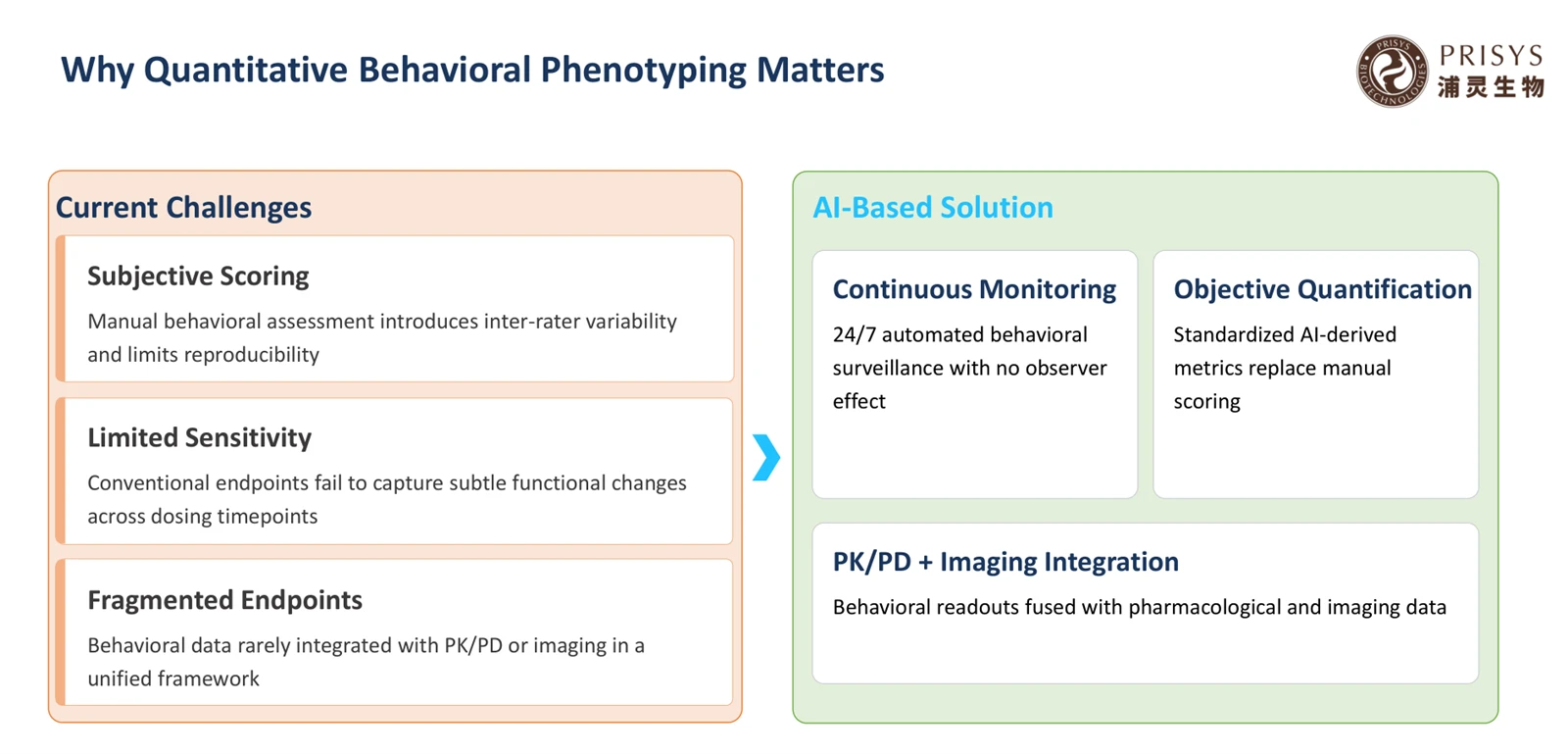
Two-dimensional video analysis records more but resolves less. It tends to report simple parameters such as total movement distance and overall activity level, and it does not separate individual limb trajectories, three-dimensional posture change or movements that involve several body parts at once.
Marker-based motion capture carries richer kinematic information, at the cost of hardware on the animal. Reflective markers or tracking devices add handling, and in some experimental settings they interfere with natural movement or with monitoring over weeks.
These limitations encouraged the development of markerless 3D behavioral analysis, which pairs video observation with AI-assisted movement reconstruction.
How AI-Powered Markerless 3D Behavioral Analysis Works
3D behavioral phenotyping combines multi-view video acquisition, computer vision, deep learning-based pose estimation and behavioral data analysis. Markerless systems identify anatomical landmarks directly from video images instead of relying on reflective markers fixed to the animal.
1. Synchronized Multi-View Video Acquisition
Recording comes first, with several cameras positioned around a defined recording environment. In the NHP acquisition configuration presented in our technical webinar, four synchronized cameras sit around the recording enclosure and capture overlapping views of a freely moving animal.
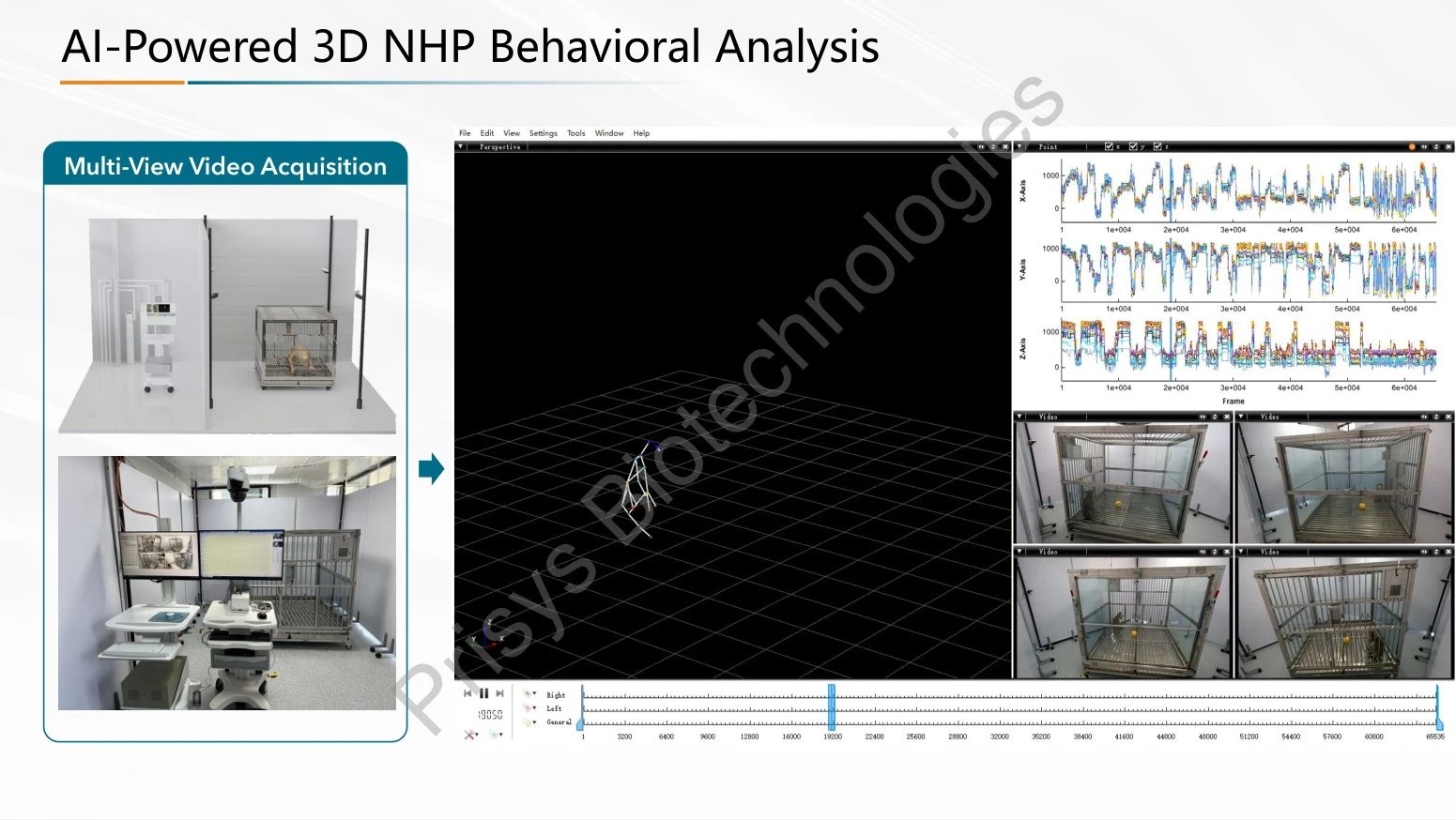
Overlap is the point. A single camera cannot see every movement from every direction, and body parts go out of view when the animal turns, climbs, interacts with objects or changes posture. Synchronized recording lets images from different angles be analyzed together and supplies the spatial information that three-dimensional reconstruction needs.
Camera positions, lighting, the recording environment and the observation procedure follow from the intended behavioral endpoints and the study objectives.
2. Markerless 3D Pose Estimation
AI-based computer vision models then identify anatomical landmarks in the recorded images and use them to estimate body configuration and rebuild a three-dimensional skeletal representation. Posture change and the movement of individual anatomical regions are tracked over time without markers on the animal.
Compared with simple activity monitoring, 3D pose estimation describes how an animal moves: limb trajectories, posture transitions and coordinated movement between body parts.
Reconstruction quality depends on camera calibration, synchronization, the visibility of anatomical landmarks and the extent of occlusion.
3. Quantitative Behavioral Analysis
Three-dimensional movement data convert into quantitative behavioral parameters across four levels.
Motion Kinematics
Motion kinematics describes the dynamics of movement. Velocity, acceleration and movement trajectory characterize spontaneous activity and changes in locomotor pattern, and separate baseline from post-treatment conditions.
Limb Position and Gait Tracking
Limb positions tracked over time characterize locomotion, coordination and motor abnormality. In neurological disease models this level shows change in left-right limb coordination, movement symmetry, gait characteristics and fine motor performance.
Three-Dimensional Pose Estimation
Pose estimation in spatial coordinates describes body posture and joint movement, which matters for behaviors that distance travelled or two-dimensional video cannot characterize.
Automated Behavioral Segmentation
Behavioral segmentation identifies and classifies specific behavioral states or events from video-derived movement. Depending on the analytical model and its validation status, that covers locomotion, grooming, scratching, climbing, posture transitions or repetitive movement patterns. Automated segmentation cuts the manual video review that large datasets and longitudinal studies would otherwise require.
The four levels are complementary, not interchangeable: the right combination follows from the scientific question, the target behavior and the validation status of the model.
Applications in NHP Preclinical Research
Quantitative behavioral phenotyping applies across therapeutic areas where functional change indicates disease or treatment response.
CNS and Neurodegenerative Disease Research
In neurological disease models, motor change shows up as reduced movement, abnormal gait, impaired coordination or altered spontaneous activity. Parkinson's disease and other neurodegenerative conditions alter motor control progressively, and tracking bilateral hand movement, limb trajectory and locomotor pattern adds quantitative endpoints for those abnormalities. Repeated measurement over the study then shows whether motor performance changes with treatment.
Pain and Pruritus Research
Pain and pruritus produce recognizable behavioral responses: scratching, changed movement patterns, altered spontaneous activity. In NHP pruritus studies, automated scratching analysis measures scratching frequency, duration and temporal distribution, and three-dimensional movement data can help separate scratching from grooming or routine body movement that uses similar limb movements.
These measurements complement clinical observation and other pharmacodynamic endpoints in the evaluation of anti-pruritic or anti-inflammatory candidates.
Gait and Motor Function Assessment
Gait analysis is a direct application. Reconstructed limb trajectories and body posture during locomotion show change in movement symmetry, coordination and gait characteristics. Because no markers are attached, movement is recorded under naturalistic conditions designed for the study. Repeated motor function assessment in neurological disease models, and in studies of functional recovery, is where this matters most.
Longitudinal Behavioral Phenotyping
Behavioral change is not always an isolated event. In some models, altered spontaneous activity, exploration, repetitive movement or behavioral state distribution develops gradually. Longitudinal video acquisition with automated analysis compares behavioral patterns across study periods and treatment conditions, including how movement distributes, how activity patterns shift and how repetitive behavior changes over time.
Interpretation has to account for recording conditions, baseline activity, animal adaptation and other sources of behavioral variability.
Implementing AI-Powered Behavioral Analysis in Prisys NHP Studies
At Prisys Biotech, AI-powered 3D behavioral phenotyping is incorporated into non-human primate pharmacology studies as an additional functional assessment.
Our primary focus is the design and execution of NHP in vivo research: animal preparation, study-specific behavioral assessment planning, recording protocol design, video acquisition, and integration of behavioral measurements with other pharmacological endpoints. For the AI-assisted analysis itself, Prisys coordinates specialized computer vision and 3D behavioral analysis technologies according to the requirements of each research program.
The workflow connects study design with multi-view video recording, three-dimensional movement reconstruction and quantitative behavioral analysis, so behavioral measurements are read in the context of the animal model, the treatment conditions and the study objectives.
Behavioral readouts are not reported in isolation. Their scientific value depends on how closely the selected measurements match the disease phenotype and the pharmacological question. Where appropriate, behavioral endpoints sit alongside PK/PD data, clinical imaging, physiological measurements and pathological assessment to support a fuller evaluation of drug response in NHP models.
Methodological Considerations: Validation and Study Design
AI-powered behavioral analysis opens new measurement options, but its outputs are not automatically validated pharmacodynamic endpoints.
Behavior-Specific Validation
An AI model is evaluated against defined reference annotations, including human-reviewed video segments where available. Validation targets the behaviors relevant to the study, because high overall pose-tracking performance does not establish accurate recognition of every behavioral category. Detecting general limb movement is not the same as distinguishing scratching from grooming, and each target behavior needs an operational definition and its own classification performance data.
Recording Configuration
Camera arrangement, synchronization, lighting, recording environment and animal positioning all affect video quality. A model configured under one recording setup is not assumed to perform identically under different conditions: changes in camera geometry, animal characteristics or recording environment require additional calibration and validation.
Occlusion and Data Quality
Occlusion occurs when the animal's own body, cage structures or other objects hide body parts, which reduces pose estimation reliability in individual frames. Data quality assessment therefore covers tracking confidence, missing landmarks and the proportion of usable recording time.
Behavioral Endpoint Definition
The target behavioral endpoint is defined before the study begins: what counts as a behavioral event, how events are counted, which observation periods are relevant, and how the resulting measurements will be interpreted. Complex behaviors and disease-specific phenotypes need this settled in advance, because automated classification of those behaviors requires additional model configuration and validation.
AI-derived measurements are most useful in translational work when they are scientifically defined, reproducible and interpreted together with other relevant endpoints.
The Role of Quantitative Behavioral Phenotyping in Translational Drug Development
AI-powered 3D behavioral phenotyping adds a method for studying functional change in non-human primates. Synchronized video acquisition, markerless pose estimation and automated behavioral analysis move the readout past simple activity counts toward movement, posture, coordination and selected behavioral patterns.
For CNS, pain and other therapeutic areas where functional outcome matters, these measurements complement established pharmacological and physiological endpoints.
At Prisys, quantitative behavioral assessment is part of a broader NHP translational research workflow. What carries the scientific weight is the link between a carefully designed in vivo experiment and a behavioral measurement that is biologically meaningful and properly validated.
Later articles in this series cover specific applications, including automated scratching recognition, bilateral motor coordination, markerless gait analysis, longitudinal behavioral assessment and the integration of behavioral data with other pharmacological endpoints.
Explore the Application Series
This article sets out the methodological foundation. The following articles examine how the approach applies to specific NHP research questions:
- Automated Scratching Behavior Recognition in Cynomolgus Macaques. Quantifying pruritus-related behavioral endpoints with 3D pose estimation and motion analysis.
- Bilateral Motor Coordination Assessment in NHP Models. Evaluating left-right movement trajectories and functional motor abnormalities.
- Markerless 3D Gait Analysis in Non-Human Primates. Characterizing locomotion, limb trajectories and movement coordination.
- Longitudinal Behavioral Phenotyping and Stereotypic Behavior Analysis. Monitoring changes in activity patterns and repetitive behavior across study conditions.
- Integrating AI Behavioral Analysis with NHP Pharmacology. Connecting behavioral endpoints with PK/PD, imaging, physiological monitoring and other translational measurements.
Quantitative behavioral phenotyping supports the design of more informative NHP preclinical studies.
About Prisys Biotech
Prisys Biotech specializes in non-human primate disease models, preclinical pharmacology and translational research. Its capabilities cover in vivo efficacy evaluation, behavioral assessment, clinical imaging and integrated pharmacological studies for pharmaceutical and biotechnology companies. For research collaboration or NHP study design inquiries, contact bd@prisysbiotech.com.
Related Reading
Prisys Contributes To Nature Neuroscience Study On Psychedelic Pharmacology And Behavioral Responses