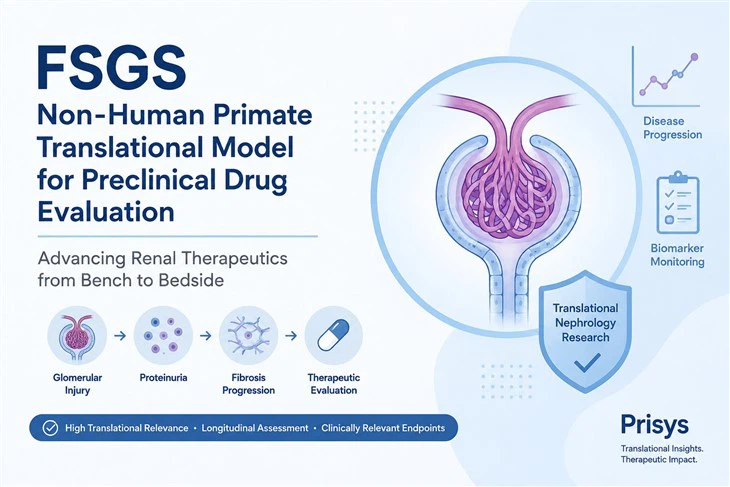
Focal Segmental Glomerulosclerosis (FSGS) NHP Model
Introduction to Focal Segmental Glomerulosclerosis (FSGS) and Translational Challenges
Focal Segmental Glomerulosclerosis (FSGS) is a progressive glomerular disorder characterized by podocyte injury, segmental glomerular sclerosis, proteinuria, and gradual decline of renal function. Clinically, FSGS is one of the causes of steroid-resistant nephrotic syndrome and end-stage renal disease (ESRD), representing a major unmet need in nephrology drug development.
Despite substantial progress in understanding podocyte biology and glomerular injury pathways, translational success in FSGS therapeutics remains limited. One major challenge lies in the insufficient predictive value of traditional rodent models, which often fail to fully recapitulate the complex pathological remodeling, chronic progression, and fibrotic changes observed in human disease.
Non-human primate (NHP) models provide a highly relevant translational platform for nephrology research due to their close similarity to humans in renal anatomy, glomerular structure, immune responses, and hemodynamic regulation. In particular, chemically induced cynomolgus monkey models using Adriamycin (ADR) or Puromycin Aminonucleoside (PAN) have emerged as valuable tools for evaluating novel anti-proteinuric, anti-inflammatory, and anti-fibrotic therapeutics.

At Prisys Biotech, translational nephrology studies are supported by integrated NHP pharmacology capabilities, longitudinal biopsy-based assessments, clinical-equivalent imaging systems, and advanced pathology analysis platforms to facilitate clinically relevant renal disease research.
Pathophysiological Basis and Model Induction Strategies
The core pathological hallmark of FSGS is podocyte injury and depletion. Loss of podocyte integrity disrupts the glomerular filtration barrier, resulting in proteinuria, capillary loop exposure, mesangial expansion, segmental sclerosis, and eventually tubulointerstitial fibrosis.
In progressive disease stages, persistent glomerular injury triggers inflammatory cell infiltration, extracellular matrix accumulation, and irreversible nephron remodeling. These pathological events are closely associated with chronic kidney disease progression and declining renal function. To reproduce these processes in translational animal models, chemical induction approaches are commonly employed in NHPs.
Adriamycin (ADR)-Induced FSGS Model
Adriamycin-induced nephropathy is established through repeated intravenous administration of low-dose Adriamycin. ADR directly induces podocyte toxicity and oxidative stress, resulting in progressive glomerular injury and fibrotic remodeling. The model is particularly valuable for evaluating therapies targeting renal fibrosis and chronic kidney disease progression.
Puromycin Aminonucleoside (PAN)-Induced Model
Puromycin Aminonucleoside induces podocyte damage through cytoskeletal disruption and glomerular filtration barrier impairment. PAN-induced models typically demonstrate marked proteinuria and early glomerular changes, and are also useful for studying minimal change disease (MCD)-like phenotypes and podocyte biology. Both models provide clinically relevant pathological endpoints and allow longitudinal evaluation of disease progression.
Limitations of Traditional Rodent Models in FSGS Research
Rodent nephropathy models have historically played an important role in mechanistic studies. However, important interspecies differences limit their translational predictive value for human FSGS. Compared with humans, rodents exhibit substantial differences in:
- Anatomical Architecture: Nephron number and glomerular size differ markedly between rodents and primates.
- Drug Sensitivity: Podocyte sensitivity to nephrotoxic agents varies across species.
- Hemodynamics & Immunology: Renal hemodynamics and immune/inflammatory responses are distinct in rodents.
- Fibrosis Kinetics: Fibrosis progression kinetics do not fully mirror clinical scenarios.
Many rodent FSGS models primarily display transient proteinuria or reversible lesions without fully reproducing the focal and segmental pathological progression observed clinically. In addition, severe tubulointerstitial fibrosis and chronic remodeling are often inadequately represented. Non-human primates provide a more physiologically relevant platform for modeling chronic glomerular injury and progressive renal fibrosis. Their human-like renal architecture and immune responses support improved translational assessment of therapeutic efficacy, biomarker dynamics, and safety profiles.
Translational Advantages of NHP FSGS Models
The major strength of NHP FSGS models lies in their ability to support clinically relevant longitudinal evaluation within the same animal over extended study durations.
Human-Relevant Renal Physiology
Cynomolgus monkeys possess renal anatomical and physiological features highly comparable to humans, including glomerular organization, filtration dynamics, and inflammatory signaling pathways. This improves the predictive value of pharmacological responses and disease progression patterns within the comprehensive NHP Nephrology Platform.
Longitudinal Kidney Biopsy Assessments
Unlike many rodent studies relying on terminal endpoints, NHP models allow serial kidney biopsy collection throughout the study period. Longitudinal histopathological monitoring enables dynamic evaluation of glomerular sclerosis progression, podocyte injury, mesangial matrix expansion, and tubulointerstitial fibrosis. This repeated-measures design substantially reduces inter-animal variability and improves statistical sensitivity.
Integrated Biomarker Evaluation
NHP FSGS studies can incorporate multidimensional biomarker analyses, including urinary total protein and albumin, serum creatinine and BUN, inflammatory cytokines, histopathological fibrosis markers, and molecular biomarker profiling. These endpoints improve translational alignment with clinical nephrology studies and facilitate IND-enabling decision-making.
Compatibility with Advanced Translational Technologies
At Prisys Biotech, NHP nephrology research can be integrated with advanced translational platforms, including clinical-grade MRI and CT imaging supported by our specialized Clinical Imaging Platform. Furthermore, advanced histopathology, digital pathology analysis, and precise PK/PD Evaluation Services ensure comprehensive translational assessment.
Prisys Biotech NHP FSGS Platform
Prisys Biotech has established translational cynomolgus monkey FSGS and proteinuria models using both ADR- and PAN-based induction approaches, expanding options for evaluating candidate therapeutics under a validated Chronic Kidney Disease (CKD) NHP Model framework.
Model Establishment
Healthy male cynomolgus monkeys aged 3–5 years are typically enrolled for model induction. Repeated intravenous administration of low-dose ADR or PAN is performed according to study objectives and disease severity requirements. Induction protocols may include weekly dosing for approximately 5 weeks or extended low-dose regimens administered twice weekly for up to 9 weeks.
Histopathological classification follows clinical diagnostic principles:
- Segmental lesion: Less than 50% capillary involvement within an individual glomerulus.
- Focal lesion: Less than 50% of glomeruli affected within the examined tissue section.
Histopathological Progression
Dynamic pathological progression has been observed in ADR-induced models. At early time points, H&E staining may reveal inflammatory infiltration without overt glomerular sclerosis. As disease progresses, significant pathological remodeling develops, including synechia between glomerular capillary tufts and Bowman's capsule, segmental sclerosis with capillary lumen collapse, foam cell accumulation, and tubulointerstitial fibrosis. Both H&E and PAS staining are utilized for comprehensive pathological assessment.
Quantitative Pathology Data
In the ADR-Induced FSGS Model, animals demonstrate a pronounced fibrotic phenotype with a mesangial matrix ratio of 48.66% (vs. 36.45% in naïve animals), a mean capillary loop involvement ratio of 56.53%, a glomerulus involvement ratio of 45.43%, and a tubulointerstitial fibrosis ratio of 21.33%. In contrast, the PAN-Induced Model demonstrates comparatively milder fibrosis, featuring a mesangial matrix ratio of 41.95%, a mean capillary loop involvement ratio of 46.67%, and a tubulointerstitial fibrosis ratio of 8.70%. The PAN platform may additionally support studies related to minimal change disease (MCD)-like pathology.
Applications in Preclinical Drug Development
NHP FSGS models provide valuable support for multiple stages of nephrology drug development, including cross-validation with acute injury profiles such as the Acute Kidney Injury (AKI) Model.
- Pharmacodynamic and Efficacy Evaluation: These models can be used to assess therapeutic effects of anti-fibrotic agents, podocyte-protective therapies, biologics targeting inflammatory pathways, small molecule renal therapeutics, and cell/gene therapy approaches.
- Biomarker Validation: Longitudinal serum, urine, and biopsy analyses enable translational biomarker evaluation and target engagement assessment.
- Translational PK/PD Studies: NHP models support clinically relevant PK/PD characterization through repeated sampling, improving translational confidence for dose selection.
- IND-Enabling Research Support: The human-like pathology and longitudinal monitoring capabilities provide valuable translational evidence supporting regulatory submissions.
Future Perspectives in Translational Nephrology Research
As precision medicine and targeted renal therapeutics continue to evolve, translational nephrology research increasingly requires disease models capable of capturing complex pathological progression and multidimensional therapeutic responses. Future development of NHP renal disease platforms will likely integrate multi-omics profiling, imaging biomarkers, AI-assisted pathology analysis, and precision fibrosis assessment. At Prisys Biotech, ongoing development of nephrology platforms aims to support next-generation translational research through integrated imaging, pathology, biomarker, and pharmacology capabilities.
FAQ
Q: What are the major pathological differences between ADR- and PAN-induced FSGS models?
A: ADR-induced models generally exhibit more severe renal fibrosis and glomerular remodeling, including higher tubulointerstitial fibrosis and glomerular involvement ratios. PAN-induced models often demonstrate earlier podocyte injury and proteinuria, and may also support minimal change disease (MCD)-related studies.
Q: How are "focal" and "segmental" lesions defined in the NHP FSGS model?
A: Segmental lesions are defined as glomerular capillary injuries involving less than 50% of an individual glomerulus. Focal involvement refers to fibrosis affecting less than 50% of total glomeruli within the examined renal tissue section.
Q: Why are NHP models considered more translationally relevant than rodent models in nephrology research?
A: NHPs possess renal anatomical structures, immune responses, and disease progression patterns that more closely resemble human kidney disease. This significantly improves the predictive value for therapeutic efficacy and clinical translation compared to rodent models.
Hot Tags: focal segmental glomerulosclerosis (fsgs) nhp model, research, study, monkey, gene therapy, antibody PD pharmacology, biologics PK pharmacology, Nonhuman Primates Disease Model, nucleotide PK pharmacology, PD pharmacology, RNA PK pharmacology
You Might Also Like


Send Inquiry