Naive vs. Non-Naive NHPs: Understanding Washout Periods in Preclinical Drug Development. Planning a non-human primate (NHP) study starts with one decision: whether to use naive or non-naive animals. That choice shapes study design, data variability, timelines, animal availability, and cost.
In preclinical drug development these terms usually appear alongside a third expression, washout monkeys. Naive, non-naive, and washout are not three mutually exclusive categories of animal. Each describes a different part of an animal's experimental history and its recovery status.
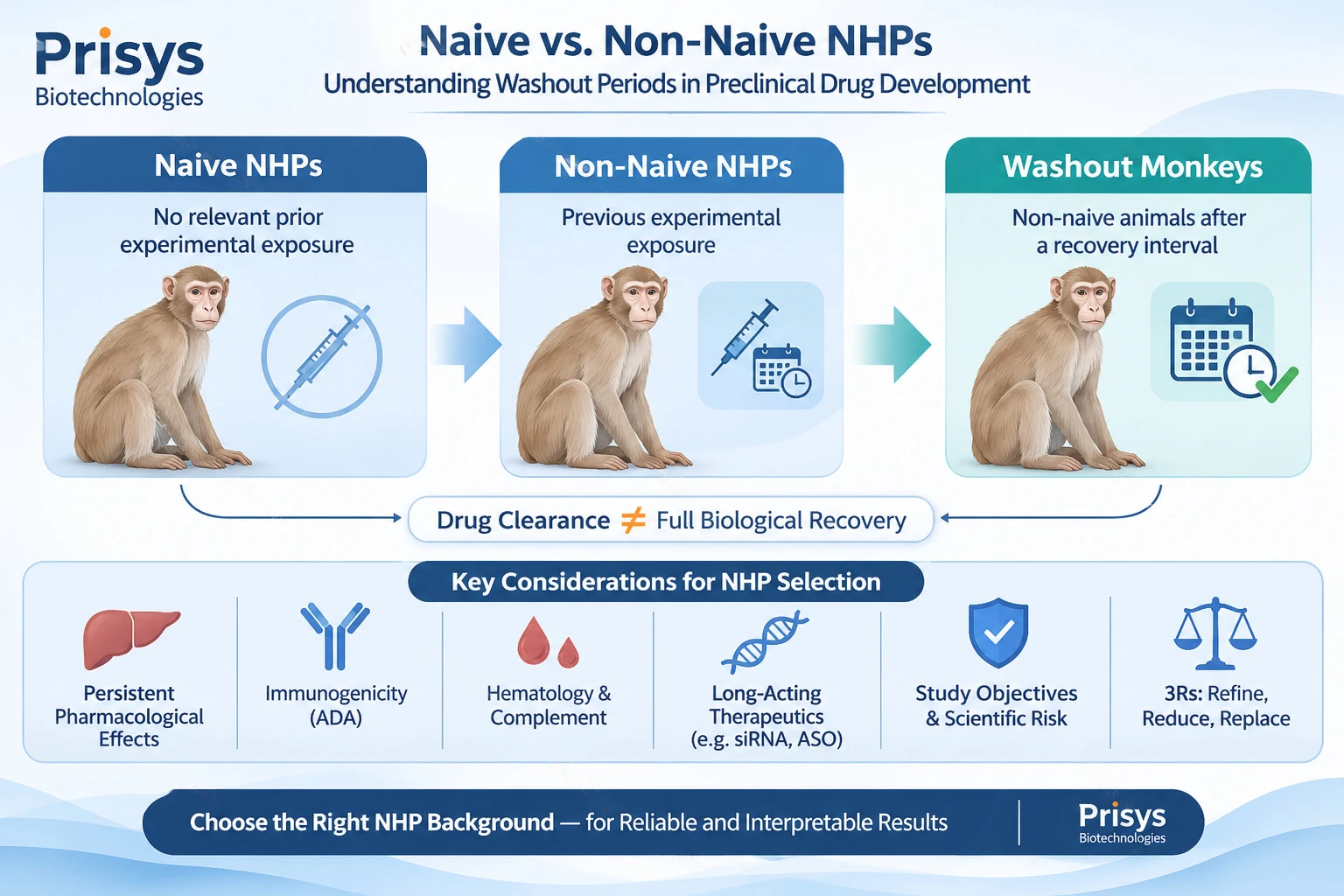
A naive monkey has no relevant prior experimental exposure under the study's own definition. A non-naive monkey has taken part in earlier procedures, received investigational compounds, or undergone disease induction or another intervention. A washout period is the interval after a previous exposure during which residual drug and its biological effects are allowed to diminish or resolve.
The distinction matters because a drug that has left the circulation has not necessarily taken its pharmacological, immunological, or tissue-level effects with it.
For pharmaceutical and biotechnology companies running NHP pharmacology, pharmacokinetic (PK), pharmacodynamic (PD), and exploratory safety studies, selecting animals takes more than counting the days since the last experiment.
Quick Answer: What Is the Difference Between Naive, Non-Naive, and Washout Monkeys?
Naive monkeys have no relevant prior experimental exposure. Non-naive monkeys have a documented history of previous studies, dosing, disease induction, or procedures. Washout describes the recovery interval after an exposure rather than a separate animal category. A monkey that has completed a washout period is still non-naive, even when residual drug concentrations are no longer detectable.
1. Understanding Naive and Non-Naive NHPs
In NHP research, naive and non-naive animals are separated by their previous experimental history. The operational definition of naive varies between facilities and study types, so confirm it with the animal supplier or CRO before the study is designed.
Naive NHPs
Naive NHPs have not previously received investigational treatments or undergone relevant experimental interventions that could influence the planned study.
Investigators usually prefer them when the study needs a well-characterized starting condition, particularly for sensitive pharmacological pathways, immunological responses, or disease induction.
In an NHP efficacy study of a novel immunomodulatory biologic, previous exposure to another immunologically active compound could alter baseline immune status or the response to treatment. Starting with appropriately characterized naive animals removes that source of uncertainty.
Naive also does not mean untouched by routine veterinary procedures, husbandry handling, or basic health monitoring. Those background activities belong in a different category from prior experimental exposure.
Non-Naive NHPs
Non-naive NHPs have documented previous experimental experience: drug administration, blood collection, disease modeling, surgery, imaging examinations, or other study-related interventions.
Being non-naive does not make an animal unsuitable for future research.
An animal from an earlier study can serve another project, provided its historical exposure, current physiological condition, recovery status, and fit with the new objectives have been assessed.
An animal previously exposed to a pharmacologically unrelated compound, for example, may be considered for an exploratory study once residual exposure and potential biological interference have been reviewed.
What matters is not the fact of earlier participation but whether that history could compromise interpretation of the new study's endpoints.
Washout Monkeys
Preclinical researchers use washout monkey to describe an NHP that has finished a previous study or dosing period and then completed a washout interval.
Scientifically, washout is a process rather than an animal classification.
A monkey that has completed a sufficient washout period remains a non-naive animal, because waiting does not erase its experimental history.
The point carries more weight for biologics, nucleic acid therapeutics, gene therapies, and compounds with prolonged pharmacological activity.
Comparison of the Three Terms
|
Dimension
|
Naive NHP
|
Non-Naive NHP
|
Washout NHP
|
|
Definition
|
No relevant prior experimental exposure
|
Previous experimental exposure
|
Non-naive animal after a recovery interval
|
|
Previous dosing
|
None relevant to the study
|
May have received previous compounds
|
Has received previous compounds or interventions
|
|
Experimental history
|
Relatively limited
|
Requires historical review
|
Requires historical review
|
|
Residual drug concerns
|
Generally not related to previous investigational dosing
|
Depends on prior exposure
|
Depends on compound and washout
|
|
Biological carryover
|
Lower risk from previous experimental interventions
|
May be present
|
May persist despite drug clearance
|
|
Suitability
|
Depends on study objectives
|
Requires case-specific assessment
|
Requires case-specific assessment
|
Washout status says nothing about whether an animal has returned to a naive biological state.
2. Why Is Drug Clearance Not the Same as Biological Recovery?
A common assumption in NHP study planning is that a long enough washout period restores the animal's physiological condition. It does not, at least not by default.
Drug elimination and biological recovery are related processes that run on different clocks. A compound can leave plasma while its downstream pharmacological effects remain measurable for weeks or months.
Evaluating a previously exposed NHP therefore takes three lines of evidence: residual drug exposure, persistence of pharmacological effects, and change in physiological or immunological status.
2.1 Plasma Drug Clearance Does Not Guarantee PD Recovery
Pharmacokinetic washout is usually estimated from the elimination half-life.
Under simplified conditions, roughly five elimination half-lives remove more than 95% of a compound from the relevant compartment, and seven half-lives correspond to about 99%.
Those calculations assume straightforward elimination kinetics. They do not account for active metabolites, tissue accumulation, target-mediated disposition, or slow release from tissue compartments.
They also describe drug elimination, not the recovery of biological function.
Receptor occupancy, enzyme inhibition, immune-cell modulation, and downstream signaling changes can all outlast undetectable circulating concentrations.
An appropriate washout interval therefore has to cover PK and PD recovery, not plasma concentrations alone.
2.2 Long-Acting Nucleic Acid Therapeutics: Persistent Effects Beyond Plasma Clearance
Liver-targeted oligonucleotide therapeutics, including small interfering RNA (siRNA) and antisense oligonucleotides (ASOs), show why conventional washout calculations fall short.
Some GalNAc-conjugated siRNA therapeutics enter hepatocytes and silence genes through intracellular mechanisms built on the RNA-induced silencing complex (RISC).
Circulating concentrations often fall within days while intracellular pharmacological activity continues considerably longer.
These events therefore do not happen together:
- Decline of circulating drug concentrations.
- Reduction of intracellular drug exposure.
- Recovery of target mRNA expression.
- Restoration of target protein concentrations.
- Normalization of downstream physiological functions.
For an animal previously dosed with a liver-targeted oligonucleotide, a plasma-based washout assessment tells only part of the story.
That gap matters most when the next study reads out on hepatic metabolism, lipid regulation, complement biology, coagulation, or another pathway the earlier treatment could have touched.
Additional molecular or functional testing can characterize recovery when the previous target and the relevant assays are known. No single routine panel establishes that every affected pathway has returned to baseline.
Multi-client CRO work adds a harder constraint. Previous sponsors' compound identities, target sequences, and proprietary chemical modifications are confidential. A CRO cannot pass one sponsor's intellectual property to another, and retrospective target-specific testing may be impossible without the necessary information and assays.
Where hepatic molecular pathways sit at the center of the primary endpoints, well-characterized naive animals give a more defensible starting point.
2.3 Hematology, Complement, and Coagulation: Normal Laboratory Results May Not Tell the Whole Story
Hematological and immunological studies raise the same question in a different form.
Routine clinical pathology, including red blood cell counts, hemoglobin, platelet counts, and leukocyte differentials, describes the animal's current condition.
Normal peripheral blood values do not establish that every underlying process has recovered.
Earlier interventions affecting erythropoiesis, thrombopoiesis, or immune regulation can leave consequences that routine counts do not capture.
In anemia induction, platelet reduction, complement inhibition, or coagulation studies, previous experimental exposure can change the magnitude or the kinetics of the next response.
How much this matters depends on the earlier intervention, its mechanism of action, the recovery period, and the sensitivity of the endpoints.
Hematological studies should pair historical exposure with baseline CBC, reticulocyte counts where relevant, coagulation parameters, and mechanism-specific assessments.
2.4 Biologics and Immunogenicity: The Importance of ADA History
Previous exposure to a biological therapeutic adds a second source of variability: immunogenicity.
Monoclonal antibodies, bispecific antibodies, fusion proteins, and other biologics can induce anti-drug antibodies (ADA) after dosing.
ADA can then affect drug exposure, target engagement, pharmacological activity, and the reading of safety findings.
An animal with prior biologic exposure needs additional assessment before it enters another biologics study.
Screening for ADA against the new investigational product does not cover every consequence of earlier immune exposure.
A molecule-specific ADA assay detects antibodies that recognize the relevant test article. It does not map all forms of immune memory, cross-reactivity, or broader immunological change from previous interventions.
For biologics PK/PD studies, the assessment should cover the previous therapeutic modality, potential antigenic relationships, available immunogenicity data, and the requirements of the new study.
3. How Should NHPs Be Selected for Different Preclinical Studies?
The suitability of naive and non-naive NHPs follows from the scientific objectives rather than from a rule of thumb.
No universal washout duration or animal classification fits every compound and every design. The framework below is a starting point for evaluating animal suitability.
3.1 Exploratory PK Studies
For exploratory PK work with conventional small molecules that have well-characterized elimination profiles, selected non-naive animals can be suitable under the right conditions.
The assessment covers previous compound exposure, potential pharmacokinetic interactions, relevant tissue persistence, and baseline clinical pathology.
Where the previous compound acts through a different mechanism and does not interfere with the analytical method or the current test article, biological carryover is often manageable.
Previous exposure can still confound analytical or physiological readouts, particularly in sensitive PK measurements or repeated-dose designs.
3.2 Biologics PK/PD Studies
Biologics need closer attention because target-mediated clearance, prolonged target engagement, and immunogenicity shape both disposition and activity.
Prior exposure to another biologic does not disqualify an animal. The previous molecule, its target, its immunogenicity profile, and possible cross-reactivity all belong in the assessment.
Where an accurate exposure-response relationship is critical, naive animals provide a cleaner experimental background.
Where non-naive animals are considered, the study should include pre-study immunogenicity testing and the relevant baseline measurements.
3.3 Disease-Model-Based Pharmacology and Efficacy Studies
For NHP efficacy studies, selection has to weigh previous interventions against the biology under investigation.
A non-naive animal can serve an efficacy study when its previous exposure is unrelated to the new mechanism and does not compromise the model or the primary endpoints.
Greater caution applies when earlier interventions could have left persistent change in disease-related pathways, immune function, organ physiology, or neurological behavior.
Chronic disease models and long-lasting molecular interventions carry the most risk.
A previously treated animal can show unremarkable routine clinical pathology and still have altered baseline target expression or pharmacodynamic responsiveness.
In those cases naive animals reduce uncertainty in baseline characterization and make treatment effects easier to interpret.
3.4 Non-GLP Exploratory Safety and Tolerability Studies
Non-GLP exploratory safety studies characterize early tolerability, identify potential adverse effects, and inform later development decisions.
Non-GLP status does not make non-naive animals unsuitable, but previous experimental exposure needs careful review.
Historical change in organ function, immune status, hematology, or other safety parameters can complicate attribution of new findings to the investigational product.
Where the goal is a reliable initial safety profile or the characterization of dose-limiting findings, naive animals are usually the simpler choice.
The decision should reflect study objectives, the intended interpretation of the findings, and the quality of the available history.
Practical Animal Selection Framework
|
Study Type
|
Potential Suitability of Non-Naive NHPs
|
Key Considerations
|
|
Exploratory small-molecule PK
|
Conditional
|
Previous drug exposure, PK interference, washout, analytical compatibility
|
|
Biologics PK/PD
|
Requires careful assessment
|
ADA, target overlap, target-mediated disposition, immunogenicity
|
|
NHP disease-model efficacy
|
Mechanism-dependent
|
Disease history, previous interventions, baseline PD and model stability
|
|
Nucleic acid therapeutics
|
Generally requires greater caution
|
Intracellular persistence, target recovery, tissue-level pharmacology
|
|
Hematology and complement studies
|
Requires careful assessment
|
Previous effects on blood-cell production, immune regulation, coagulation, and complement
|
|
Non-GLP exploratory safety
|
Generally favor naive animals when feasible
|
Historical organ effects, immune status, baseline abnormalities, safety attribution
|
These are planning recommendations, not fixed eligibility criteria. The compound, the objectives, and the animal's actual history decide the final selection.
4. What Should Be Evaluated Before Reusing a Non-Naive NHP?
Reusing a non-naive monkey defensibly requires an integrated review of its experimental history and current physiological status.
Confirming that a certain number of days have passed since the last experiment is not enough.
Historical Exposure Review
Start with what the animal was exposed to.
The record should cover previous investigational compounds, therapeutic modalities, dosing routes, dose levels, administration schedules, disease-induction procedures, surgical interventions, and the date of last exposure.
Mechanism of action matters here, because two compounds with very different chemical structures can act on the same biological pathway.
Where sponsor confidentiality blocks full disclosure, the CRO should state the limits of the available information and the uncertainty that follows.
PK and PD Recovery Assessment
The next step is to establish whether the previous compound and its biological effects have sufficiently diminished.
Depending on the modality, this may involve:
- Review of elimination half-life and active metabolites.
- Assessment of potential tissue accumulation or prolonged exposure.
- Relevant drug concentration measurements.
- Receptor occupancy or target engagement assessment, where applicable.
- Target mRNA or protein recovery for selected molecular therapeutics.
- Evaluation of pharmacodynamic biomarkers.
The right tests depend on the previous compound and the new study's primary endpoints. No universal panel establishes complete biological recovery across all modalities.
Baseline Clinical and Physiological Evaluation
Before enrollment, animals should undergo assessments appropriate to the study objectives.
Common evaluations include body weight, general clinical condition, hematology, serum biochemistry, and coagulation parameters.
Studies of specific organ systems, immune pathways, or neurological function require additional assessments.
For biologics, pre-screening for ADA against the new test article may also be appropriate.
The animal does not have to match a naive animal on every parameter. What matters is whether its current condition gives an acceptable, interpretable baseline for the planned research.
5. The Role of Animal Selection in the 3Rs Framework
Appropriate use of previously studied NHPs supports the Reduction principle of the 3Rs: Replacement, Reduction, and Refinement.
Where the science justifies it, reuse lowers the total number of animals a program needs.
Animal reuse is not a goal in its own right.
Where previous exposure introduces substantial biological uncertainty, the resulting variability can compromise interpretation, require additional animals, or force a repeat study.
The 3Rs principle works alongside scientific justification, veterinary assessment, ethical review, and sound study design.
Reuse makes sense in specific situations, and naive animals remain necessary where a reliable experimental baseline is the point.
6. How Prisys Approaches NHP Selection for Preclinical Research
At Prisys Biotechnologies, NHP selection follows the planned pharmacological objectives rather than animal availability.
As a CRO working on NHP pharmacology, disease-model-based efficacy evaluation, and translational PK/PD research, Prisys treats the experimental background of an animal as part of baseline characterization and of how treatment responses are read.
For projects using non-naive animals, the assessment covers available historical exposure information, relevant washout requirements, current clinical condition, and potential biological interference with the planned endpoints.

Depending on the study, that means reviewing previous dosing and procedural records, evaluating baseline hematology and clinical chemistry, and considering mechanism-specific assessments such as ADA screening or target-related biomarkers.
Studies of biologics, nucleic acid therapeutics, immune modulation, or compounds with persistent pharmacological effects call for closer attention to exposure history.
Prisys helps sponsors evaluate animal suitability during study planning, with animal background, study design, and pharmacological endpoints matched from the start.
Where the available history cannot support an acceptable level of confidence, the limitations are raised before study initiation rather than after data collection.
Selecting the Right NHP Background Before Study Initiation
Naive, non-naive, and washout status are not interchangeable. A washout period can reduce residual drug exposure; it does not erase experimental history or restore every affected biological pathway.
For preclinical NHP studies, animal selection should follow the therapeutic modality, mechanism of action, study objectives, previous exposure history, and the sensitivity of the planned endpoints.
Appropriately screened non-naive animals can be a scientifically acceptable option for some exploratory studies. Where long-lasting pharmacological effects, sensitive immune pathways, disease-model stability, or critical safety endpoints are involved, naive animals give a more reliable start.
Make the animal selection decision before the study begins, with a clear view of both the scientific requirements and the limits of the available history.
Planning an NHP pharmacology or PK/PD study? Talk to the Prisys scientific team about animal selection, previous exposure considerations, and study design for your investigational compound.
Related Reading
- Non-Naive NHPs in Preclinical Trials: A Cost-Effective Solution
- Optimized Nonclinical Immunogenicity Evaluation Strategies
- Guiding Principles for Animal Species Selection in Nucleic Acid Drug Toxicology Studies
- Preclinical PK/PD Studies and NHP Models for Drug Development
Frequently asked questions
Q: 1. Are non-naive monkeys the same as washout monkeys?
A: No. Non-naive describes an animal's previous experimental history, while washout describes the recovery interval after a previous exposure. A washout monkey is still a non-naive animal, even when the previous compound has been sufficiently eliminated from circulation.
Q: 2. How long should the washout period be for NHP studies?
A: No single washout period applies to all NHP studies. For compounds with conventional elimination kinetics, five to seven elimination half-lives give an initial estimate of the time needed for substantial systemic clearance. Active metabolites, tissue accumulation, target engagement, and prolonged pharmacodynamic effects also have to be considered. Set the final interval from compound-specific PK and PD information.
Q: 3. Can non-naive monkeys be used for PK studies?
A: Yes, under the right conditions. Selected non-naive NHPs can serve exploratory PK studies once previous drug exposure, potential analytical interference, residual pharmacological effects, and current physiological status have been evaluated. Suitability depends on the investigational compound and the study objectives.
Q: 4. Can monkeys previously exposed to siRNA or ASO therapeutics be reused after a six-month washout?
A: Not necessarily. Some siRNA and ASO therapeutics produce pharmacological effects that persist well beyond measurable plasma exposure. Target mRNA or protein expression may not have returned to baseline even after six months. The assessment depends on the previous mechanism, the target biology, the available history, and the endpoints of the next study. A fixed six-month interval is not proof of complete biological recovery.
Q: 5. Can ADA screening eliminate the risks associated with previous biologic exposure?
A: No. ADA screening against the new investigational product identifies pre-existing antibodies that recognize the test article, but it does not characterize every immune consequence of previous biologic exposure. Historical immunogenicity, potential cross-reactivity, and other immune effects should also be considered.
Q: 6. Are naive monkeys always required for Non-GLP safety studies?
A: Not necessarily, but naive animals are often preferable when the objective is a reliable initial safety profile. Previous interventions can influence organ function, hematology, or immune responses and complicate the interpretation of new findings. Base the final decision on the study objectives and the potential impact of historical exposure.
Q: 7. What information should a CRO review before using a non-naive monkey?
A: At a minimum, the review should cover previous compound exposure, dosing route and schedule, mechanism of action, last administration date, previous disease induction or surgery, available PK/PD recovery information, and current clinical status. Additional assessments, including ADA screening or target-specific biomarkers, may be needed depending on the planned study.