

Physiologically Based Pharmacokinetic (PBPK) modeling has become an increasingly important component of modern drug development. Yet its value is sometimes reduced to two simple claims: PBPK is more accurate, or regulators increasingly accept it.
Neither explanation fully captures why PBPK is useful.
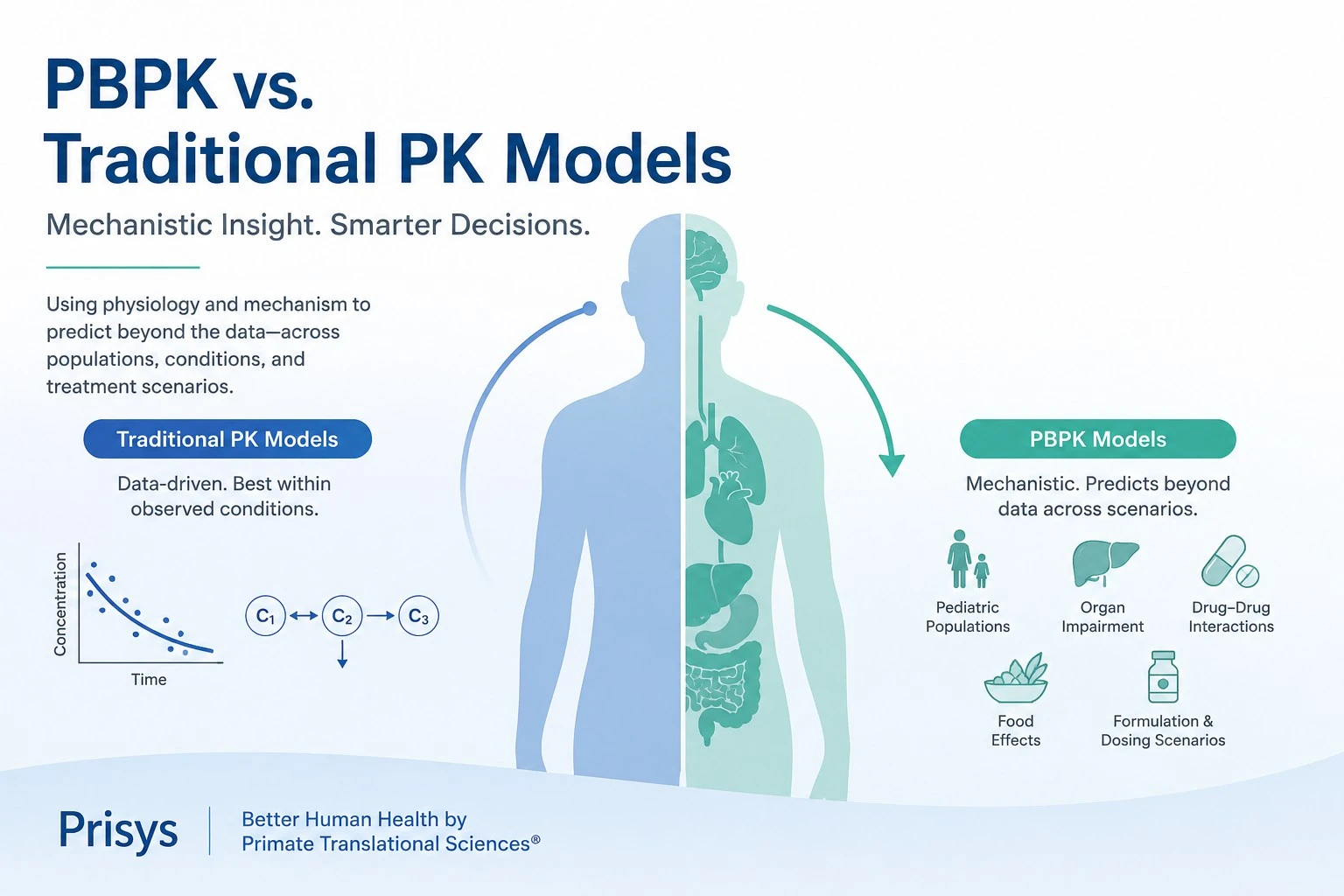
Traditional compartmental models are highly effective for describing observed pharmacokinetic data. Their main limitation is that they are primarily data-driven: parameters are estimated from measured concentration–time profiles, and the model is generally most reliable within the physiological and dosing conditions represented by those data.
Drug development, however, frequently requires decisions beyond the available clinical dataset. How should dosing be adjusted in patients with hepatic impairment? What exposure might be expected in pediatric populations? Could a co-administered drug cause a clinically relevant drug–drug interaction (DDI)? How might food alter exposure?
These are extrapolation questions. This is where PBPK provides a fundamentally different approach.
What Is the Difference Between PBPK and a Traditional Compartmental Model?
A traditional compartmental model represents the body as a small number of mathematical compartments. Parameters such as clearance (CL), volume of distribution (Vd), absorption rate constant (Ka), and elimination rate constant (ke) are estimated from pharmacokinetic observations.
This approach is relatively fast, statistically tractable, and well established for describing PK profiles. It remains an essential tool for clinical pharmacokinetic analysis.
Its limitation is not poor fitting. In fact, a compartmental model may describe observed concentration–time data very well. The problem arises when the model is used to answer questions outside the conditions from which its parameters were estimated.
For example, if a drug produces an AUC of 1,000 ng·h/mL in healthy volunteers and 2,500 ng·h/mL in patients with hepatic impairment, a compartmental model can describe the observed difference. It does not, however, provide a mechanistic basis for predicting that change before the clinical study is conducted.
PBPK modeling takes a different approach. The model structure is based on physiological and anatomical characteristics, while drug-specific parameters are derived from sources such as in vitro experiments, literature, and physiological databases. Clinical PK data are then used primarily for model verification rather than simply to estimate every model parameter.
The fundamental distinction can therefore be summarized as follows:
| Feature | Traditional Compartmental PK | PBPK |
|---|---|---|
| Model basis | Observed PK data | Physiology + drug-specific mechanisms |
| Parameter sources | Primarily clinical PK data | In vitro data, literature, physiological databases |
| Physiological interpretation | Limited | Mechanistically interpretable |
| Fit to observed data | Strong | Generally comparable when appropriately developed |
| Extrapolation | Limited | Major application |
| Tissue concentration prediction | Limited | Can support tissue-level prediction |
| Typical applications | PK description and population analysis | DDI, special populations, formulation and dosing questions |
| Development complexity | Lower | Higher |
The key point is that PBPK should not be viewed simply as a more complicated way to fit a concentration–time curve. Its principal value is the ability to connect drug properties with physiological processes and use that framework to explore conditions for which direct clinical data may be limited.
Where PBPK Adds the Most Value
The strongest application of PBPK is extrapolation across physiological, pathological, and treatment conditions.
A mechanistic PBPK model can incorporate changes in hepatic blood flow, enzyme abundance, body weight, age, organ function, and other physiological variables. This makes it possible to simulate scenarios such as hepatic or renal impairment, pediatric populations, obesity, and pharmacogenetic differences.
PBPK can also be used to evaluate alternative dosing conditions. For example, a validated model may support extrapolation from single-dose to multiple-dose exposure or from one formulation or release profile to another.
Drug–drug interaction assessment is another major application. Depending on the drug and mechanism, PBPK models can incorporate CYP-mediated metabolism, transporter effects such as P-glycoprotein (P-gp) and OATP, and enzyme or transporter inhibition and induction.
This mechanistic structure is particularly valuable when the question concerns not simply what happened in a clinical study, but why it happened and what may occur under a different physiological or treatment condition.
Regulatory Use of PBPK Is Expanding
The regulatory role of PBPK has developed considerably over the past decade.
The FDA's 2018 guidance on PBPK analyses established expectations for model format, content, and verification, particularly for DDI applications. FDA subsequently expanded its consideration of PBPK to biopharmaceutics applications, including food effects, formulation changes, and certain biowaiver-related questions. ICH M12 has further incorporated PBPK approaches into the broader framework for drug interaction studies.
According to the source material reviewed for this article, PBPK was used as key evidence in 65 of 245 new drug applications or biologics license applications reviewed between 2020 and 2024, with DDI representing the dominant application area. Other applications included organ impairment, drug–gene interactions, pediatric development, food effects, and absorption-related questions.
However, regulatory acceptance should not be interpreted as an automatic replacement for clinical studies. The intended regulatory use determines the required level of model qualification and verification.
A PBPK model may provide qualitative mechanistic support without being sufficient to justify a quantitative biowaiver. For applications involving clinical study waivers, the model must be appropriately validated for the specific intended use and conditions being evaluated.
This distinction is important when developing a PBPK strategy: the model should be designed around a clearly defined regulatory or development question rather than built as a general-purpose model without a specific decision context.
Venetoclax: An Example of Mechanistic Prediction of Food Effects
The development history of venetoclax provides a useful example of where PBPK modeling can provide information that conventional PK modeling cannot.
Venetoclax is a BCL-2 inhibitor with low solubility and permeability and a pronounced food effect. Administration with a high-fat meal can increase exposure several-fold. Traditional compartmental PK analysis can characterize the observed change in AUC, but it cannot explain the underlying absorption mechanisms or predict how changes in formulation may affect the food effect.
A mechanistic PBPK approach using the GastroPlus ACAT absorption model incorporated information including dissolution, logP, pKa, and bile-related physiological factors. The model was able to reproduce the magnitude of the food effect and explore differences associated with formulation and absorption conditions.
The importance of this example is not that PBPK produced a better fit to existing data. Rather, the mechanistic model provided a framework for understanding how physiological factors such as bile secretion and gastric emptying could influence drug absorption and exposure. Subsequent work extended this type of approach toward preclinical prediction of food effects, illustrating how PBPK can potentially move some development questions earlier in the drug development process.
What Makes a PBPK Model Credible?
The value of a PBPK model depends heavily on how it is constructed and verified.
A common mistake is to treat PBPK as an advanced compartmental model and estimate key mechanistic parameters directly from clinical PK data. For example, parameters such as intrinsic clearance (CLint), Km, or unbound fraction (fu) should be supported by independent mechanistic information rather than simply adjusted until the clinical dataset is fitted.
If the parameters are effectively derived from the same clinical data that the model is subsequently used to predict, the model may have limited value for extrapolation. As the source article emphasizes, a PBPK model should retain its mechanistic basis rather than simply placing a physiological structure around empirically fitted parameters.
Food-effect modeling illustrates another potential source of error. Food effects are not necessarily explained by a single change in gastric pH. Gastric emptying, bile acid secretion, intestinal transport, CYP3A4 or P-gp activity, and lymphatic absorption may all contribute depending on the compound. A model that excludes relevant mechanisms may reproduce one dataset while failing to predict another physiological condition.
For this reason, PBPK development should begin with the question the model is expected to answer. The required parameters, assumptions, verification datasets, and model complexity should then be determined by that intended use.
PBPK Is a Decision Tool, Not Simply a Modeling Exercise
PBPK is most valuable when it addresses a specific development decision that cannot be adequately answered by existing clinical data alone.
For one program, the priority may be DDI prediction. For another, it may be hepatic impairment, pediatric extrapolation, food effect, formulation development, or support for a regulatory submission.
A model designed around a defined question can focus its development and validation effort on the mechanisms that matter most. By contrast, attempting to build an unnecessarily comprehensive model may increase complexity without improving its usefulness for the actual development decision.
This is also why PBPK and traditional compartmental PK models should not be viewed as competing methodologies. They answer different questions and can be complementary within the same development program.
Compartmental models remain highly effective for describing observed PK and estimating exposure-related parameters. PBPK extends the analysis by providing a mechanistic framework for extrapolation beyond the original dataset.
Future Directions
PBPK modeling is also evolving alongside new experimental and computational approaches. The source material highlights increasing interest in machine-learning-assisted estimation of drug properties and the use of organoids and microphysiological systems (MPS) to generate more physiologically relevant in vitro inputs.
These developments may improve the quality and availability of model parameters, but they do not change the central principle of PBPK: the model must remain mechanistically justified, appropriately verified, and linked to a clearly defined development question.
For drug developers, the practical question is therefore not whether PBPK is more sophisticated than a compartmental model. The more useful question is whether a mechanistic model can provide a reliable answer to a decision that cannot be addressed adequately using the available data.
That is where PBPK has its greatest value in modern DMPK and model-informed drug development.
FAQ
Q: What is the main difference between PBPK and a traditional compartmental PK model?
A: Traditional compartmental models primarily use observed PK data to estimate model parameters and describe concentration–time profiles. PBPK models incorporate physiological characteristics and drug-specific mechanisms, allowing the model to be used for extrapolation across populations, disease states, dosing conditions, and drug interactions.
Q: When should a drug development program consider PBPK modeling?
A: PBPK is particularly useful when the development program needs to answer questions beyond the available clinical dataset, such as DDI prediction, hepatic or renal impairment, pediatric dosing, food effects, formulation changes, or other mechanistic extrapolation questions.
Q: Can PBPK replace a clinical PK study?
A: Not automatically. Regulatory acceptance of PBPK does not mean that a clinical study can always be waived. The acceptability of a PBPK model depends on its intended use, model qualification, verification, and the regulatory question being addressed.
Q: Why is model verification important in PBPK?
A: PBPK parameters should be supported by independent mechanistic information wherever possible, while clinical data should be used to evaluate model performance. This helps demonstrate that the model can extrapolate beyond the datasets used during development rather than simply reproduce observed clinical data.
Q: Is PBPK a replacement for traditional PK modeling?
A: No. PBPK and compartmental PK models serve different purposes. Compartmental models remain valuable for describing observed PK and estimating exposure parameters, while PBPK is particularly useful when mechanistic interpretation and extrapolation are required.


