Control group selection shapes how much of an NHP pharmacology study can be interpreted. Efficacy assessments, pharmacodynamic (PD) endpoints and exposure-response analyses all depend on whether the control group gives an appropriate reference for the changes seen in treated animals.
An observed change in a preclinical study does not by itself indicate a drug-specific effect. Disease progression, vehicle administration, surgical procedures, handling stress and ordinary biological variability all move study outcomes. Without a defined control strategy, these influences are hard to separate from the pharmacological activity of a candidate drug.
NHP studies make the choice harder. Animal numbers are limited, individuals differ at baseline, and protocols often involve disease induction, invasive procedures or repeated longitudinal assessments. A control group that does not address the relevant source of bias reduces interpretability, even when the procedures and assays are otherwise sound.
The design question is which sources of bias matter for the study question, and which control strategy covers them.
2. What Types of Control Groups Are Used in NHP Pharmacology Studies?
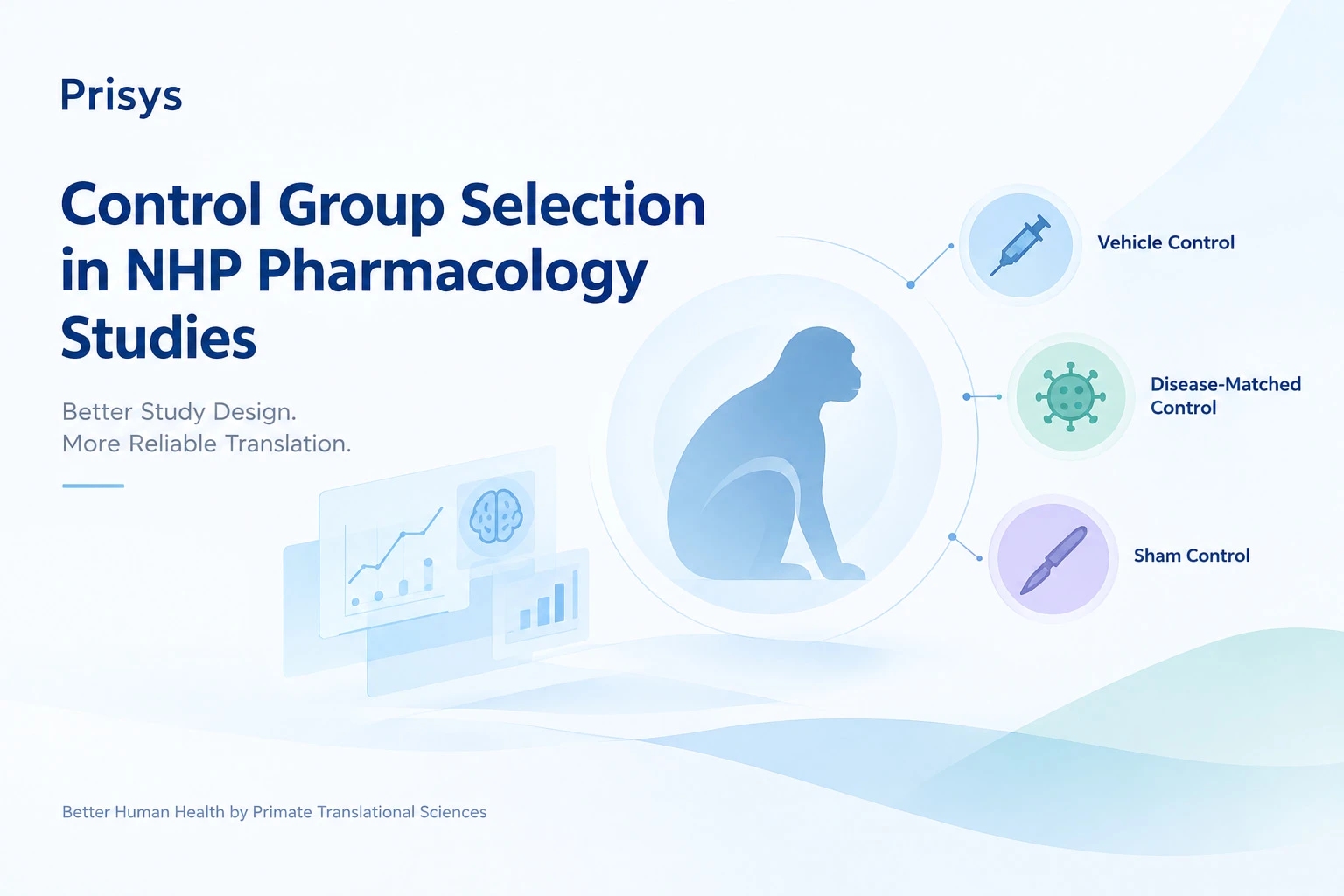
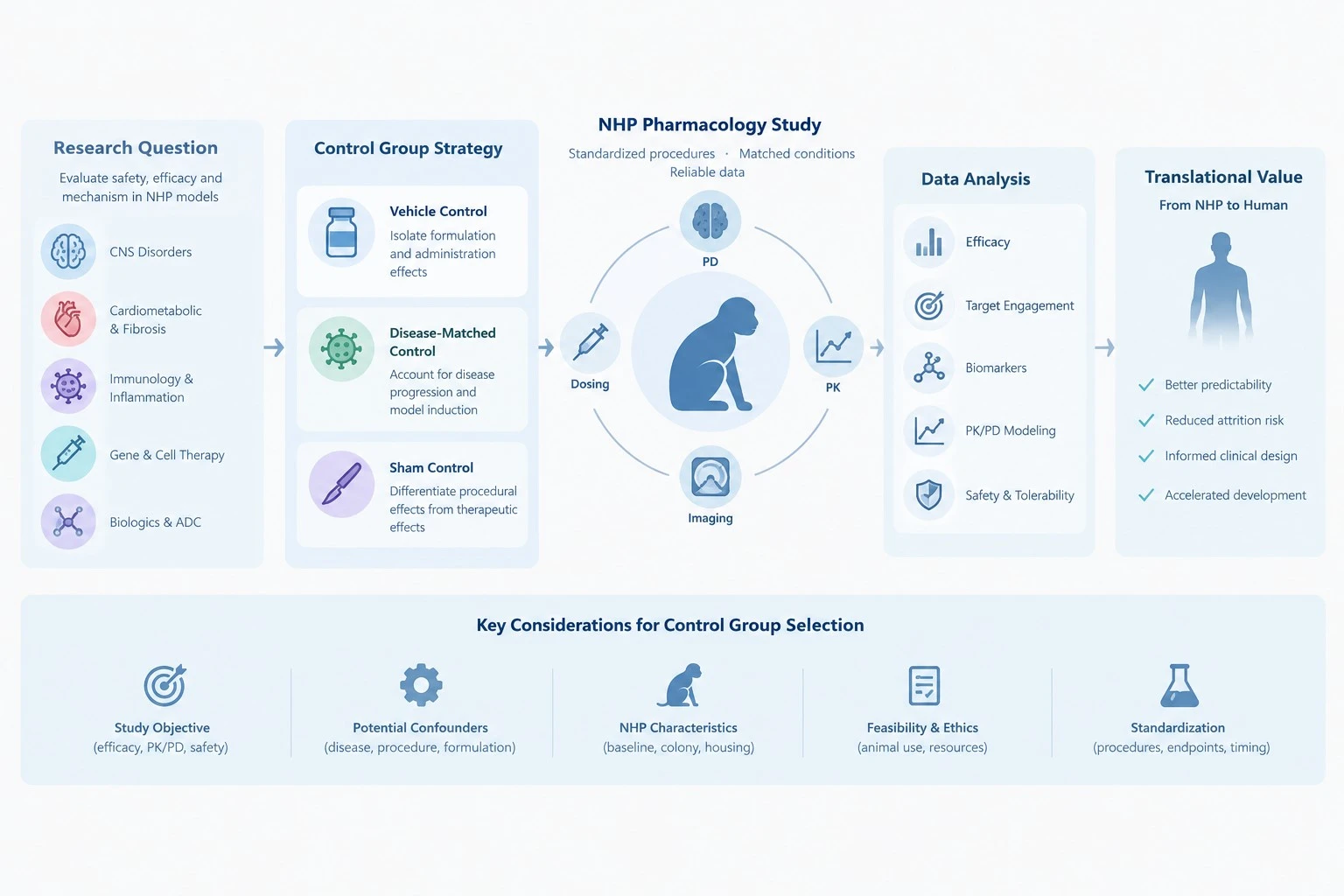
The intervention, the disease model and the intended endpoints determine the control group. Vehicle controls, disease-matched controls and sham controls cover different sources of variability, and studies often combine them.
Vehicle controls
A vehicle control receives the formulation components and the administration procedure used in the treatment group, without the active pharmaceutical ingredient (API). The group separates drug-related effects from effects of the formulation or the administration process.
Vehicle controls matter most for injectable biologics, small-molecule formulations, intrathecal administration and other delivery routes where excipients, buffers, injection volume or route affect the measured endpoint.
Consider an investigational compound given by intracerebral injection. The control strategy has to account for the delivery vehicle and for the procedure. Whether a separate sham group is also needed depends on the experimental question.
Disease-matched controls
Disease-matched controls give a reference for animals that carry the disease state or have undergone model induction. They are the right comparator when treatment effects must be separated from disease progression, spontaneous variation or the physiological consequences of model induction.
In an NHP heart failure study, animals that receive pacing-based model induction change in cardiac function over time. A disease-matched control group characterizes that trajectory independently of the investigational treatment.
A middle cerebral artery occlusion (MCAO) stroke study raises the same issue. Neurological outcomes depend on lesion characteristics, baseline functional deficits and post-procedure recovery. Comparing treated animals only with healthy animals leaves the treatment effect entangled with the lesion.
Disease-matched controls are not always untreated animals. The comparator follows from the intervention and the study objective, and from whether the question concerns efficacy against the disease state, against vehicle administration or against an established treatment.
Sham controls
Sham controls apply when the procedure itself moves the endpoints. A sham procedure reproduces the procedural components without the intervention meant to produce the experimental effect.
Surgical NHP studies carry procedural factors such as anesthesia, tissue exposure, surgical manipulation, postoperative care and recovery. For image-guided CNS delivery, the design may also need to separate the effects of the delivery procedure from those of the administered agent.
Not every surgical or interventional study needs a sham group. The group earns its place when procedural effects are material to the primary question, and when the extra animals are scientifically and ethically justified.
3. How Should Researchers Select the Appropriate Control Strategy?
Start from the primary scientific question, not from a list of control types.
The intended comparison comes first. A study of a compound's pharmacological effect usually needs a vehicle control. A study asking whether a therapy modifies disease progression usually needs a disease-matched comparator. Where surgical manipulation could influence the outcome on its own, a sham procedure enters the design.
Next, identify the confounding sources. Which factors could change the primary endpoints without any treatment? Candidates include disease severity, baseline organ function, prior treatment exposure, formulation effects, procedural injury and differences in observation schedules.
Feasibility closes the decision. NHP studies consume substantial resources and raise ethical obligations. A control group improves interpretability when it resolves a specific scientific uncertainty; an unnecessary group adds animals without proportionate scientific return. Justify sample size and group allocation against the primary endpoint, the expected variability and the study objectives.
The design question shifts with the study objective.
|
Study objective or potential confounder
|
Control strategy to consider
|
Key design question
|
|
Distinguish API effects from formulation effects
|
Vehicle control
|
Does the control match the formulation and administration procedure?
|
|
Evaluate efficacy in an established disease model
|
Disease-matched control
|
Are disease status and model-induction history sufficiently comparable?
|
|
Separate procedural effects from treatment effects
|
Sham control
|
Which procedural components could independently affect the endpoints?
|
|
Assess changes from baseline over time
|
Baseline assessment and appropriate concurrent comparator
|
Could natural progression or time-dependent variation explain the observed changes?
|
|
Compare a candidate treatment with an existing therapy
|
Active comparator, where justified
|
Is the comparison designed around the intended efficacy or pharmacological question?
|
These strategies combine. A study may need a disease-matched vehicle control together with a sham group when both formulation effects and procedural effects bear on the interpretation of efficacy. The scientific question sets the design, and the number of control groups follows from it.
4. Standardization: Beyond the Choice of Control Group
Choosing the control type is the first step. Treatment and control animals still diverge if baseline characteristics, study procedures or endpoint assessments are not standardized.
Baseline characteristics and animal allocation
Age, sex, body weight, baseline physiological measurements and disease severity all influence pharmacological outcomes. Where these matter, they belong in animal allocation and in the assessment of group comparability.
In disease models, model-induction history and phenotype severity carry particular weight. Animals that go through nominally identical induction procedures do not end up with equivalent disease states. Baseline imaging, functional measurements and model-specific endpoints characterize that variability before treatment allocation.
Housing, handling, and husbandry
Environmental conditions and animal management influence physiological and behavioral measurements. Differences in handling, housing arrangements, enrichment, feeding schedules or observation conditions add variability to stress-related, immunological, metabolic and behavioral endpoints.
Manage these factors consistently where science and welfare allow. Standardization stops short of imposing identical conditions against welfare requirements. Social housing and other husbandry decisions follow applicable welfare standards and individual veterinary assessment.
Study procedures and endpoint assessment
Dosing, sample collection, imaging, behavioral observation and postoperative care follow comparable procedures across treatment and control groups, except where the difference is intrinsic to the intervention being evaluated.
Timing matters most in longitudinal studies. PK/PD sampling schedules, behavioral assessments, imaging time points and biomarker measurements should align with the study objectives, so that group differences can be read against comparable temporal references.
Blinding of endpoint assessors, where feasible, reduces measurement bias. Prespecified evaluation criteria and consistent data-processing methods support reproducibility.
5. Why Control Group Design Matters for NHP Translational Pharmacology
Investigators turn to NHP studies when a pharmacological response has to be measured in a species with relevant similarities to human biology. The value of that choice rests on experimental design and on endpoint relevance. Species similarity on its own does not guarantee clinical predictivity.
A suitable control strategy separates treatment-related change from disease progression and procedural effects. That separation matters for functional outcomes, imaging biomarkers, circulating biomarkers and exposure-response relationships.
MRI characterizes lesion development and longitudinal change in CNS disease models. Without a suitable reference group and consistent imaging procedures, observed differences may reflect variation in baseline disease severity or natural recovery instead of a treatment effect.
Behavioral endpoints carry the same risk. In neurological disease or pruritus studies, movement and scratching behavior respond to handling, environmental conditions and the timing of observations. Standardized assessment procedures and concurrent controls improve the reading of these endpoints.
PK/PD analysis depends on the same logic. Drug exposure and pharmacodynamic response shift with baseline physiological differences, disease state, administration procedures and sampling schedules. Appropriate comparators, set against a defined sampling and analysis plan, let investigators judge whether a response fits the proposed pharmacological mechanism.
The stakes rise for biologics, gene therapies and interventions that use specialized delivery procedures. In those programs, separating the effect of the agent from the effect of its formulation or delivery method is often the study question itself.
6. Applying Control Group Principles in NHP Studies at Prisys
Prisys Biotechnologies designs NHP pharmacology studies around disease-model characterization, longitudinal endpoint assessment, clinical imaging and behavioral evaluation, in line with the requirements of the research program.
Control group selection belongs in protocol development, next to the primary endpoint, model-induction method, administration route, sampling schedule and statistical analysis plan.
CNS studies that use stereotaxic delivery or other invasive procedures need the design to address procedural effects separately from drug-specific activity. Cardiovascular studies hinge on baseline cardiac function and on how the induced phenotype progresses. Behavioral pharmacology benefits from consistent observation conditions and objective endpoint definitions, which keep treatment and control groups comparable.
Prisys runs an AAALAC-accredited NHP research facility and provides pharmacology study capabilities supported by clinical imaging infrastructure, including MRI, CT and DSA. Where the study objectives call for it, that infrastructure supports model characterization and longitudinal assessment.
The control strategy itself is set study by study. No single design fits every NHP model, therapeutic modality or research objective.
7. Practical Considerations for Future NHP Study Design
Preclinical programs increasingly combine longitudinal imaging, quantitative behavioral analysis and integrated biomarker assessment. Control group design stays central to interpreting the resulting datasets.
The working question is which sources of variation dominate the intended conclusion. Study quality comes from comparators that address the principal confounders; the count of control groups is secondary.
For NHP pharmacology, that means defining the primary comparison early, characterizing baseline disease status where needed, standardizing procedures and endpoint assessments, and building the analysis plan around the structure of the experimental design.
Each of these decisions is cheapest at protocol stage. Once data collection is under way, a missing comparator is usually beyond correction.
Frequently asked questions
Q: 1. What is the most appropriate control group for an NHP pharmacology study?
A: There is no universally appropriate control group. Vehicle controls help isolate API-related effects, disease-matched controls provide a reference for evaluating treatment effects in a disease model, and sham controls help distinguish procedural effects from intervention-specific effects. The choice depends on the primary endpoint, administration route, model-induction method and the scientific question.
Q: 2. Can healthy NHPs serve as controls in disease-model studies?
A: Healthy animals can provide useful reference data for understanding normal physiological values or the difference between healthy and diseased states. They generally cannot replace a suitable concurrent disease-matched control when the objective is to determine whether treatment modifies disease progression or reverses an established pathological phenotype.
Q: 3. When is a sham control necessary in NHP studies?
A: A sham control should be considered when anesthesia, surgery, tissue manipulation or another procedural component could independently influence the primary endpoints. Its inclusion should be justified by the scientific question, anticipated procedural effects, ethical considerations and feasibility of the study design.
Q: 4. How can researchers reduce variability between NHP treatment and control groups?
A: Researchers can improve comparability through appropriate animal allocation, baseline characterization, consistent study procedures, standardized endpoint assessments and blinded evaluation where feasible. Disease severity, model-induction history, housing conditions, sample collection timing and data-processing methods should also be considered when relevant to the study.
Q: 5. How does control group selection affect PK/PD interpretation?
A: Control groups provide context for interpreting pharmacodynamic changes and for distinguishing treatment-related effects from background variation or procedure-related responses. PK/PD interpretation also depends on appropriate sampling schedules, reliable bioanalytical measurements and consideration of differences in disease state and baseline physiology. A control group alone cannot resolve all sources of uncertainty in exposure-response analysis.