Pharmacokinetic (PK) studies are an essential part of drug development because they establish how drug exposure changes over time after administration. Well-designed PK studies help researchers characterize systemic exposure, absorption, distribution, metabolism, and elimination, and provide data that support dose selection, dosing interval, formulation development, route-of-administration decisions, and pharmacokinetic/pharmacodynamic (PK/PD) modeling.

However, there is no single PK study design that applies to every drug development program. The appropriate design depends on the characteristics of the drug, the intended route of administration, the development stage, the target indication, and the specific scientific question that the study is intended to answer.
For preclinical programs, study design may also need to account for species selection, blood sampling limitations, bioanalytical sensitivity, and the translational relevance of the selected animal model. Non-human primate (NHP) studies can provide additional translational information when species-specific biology or the properties of the drug make them appropriate.
What Is Pharmacokinetics?
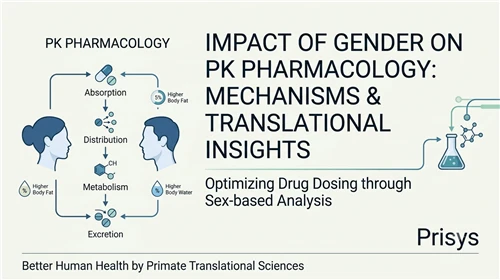
Pharmacokinetics describes the time course of drug concentrations in the body following administration. It is commonly discussed in the context of four processes: absorption, distribution, metabolism, and excretion (ADME).
Absorption describes the movement of a drug from its administration site into the systemic circulation. The extent and rate of absorption can vary substantially depending on the route of administration. For example, intravenous administration provides direct systemic exposure, whereas oral administration is affected by gastrointestinal absorption and first-pass metabolism.
Distribution describes the movement of the drug between the systemic circulation and tissues. The extent of distribution can influence the apparent volume of distribution and the duration of drug exposure in different compartments.
Metabolism involves the enzymatic transformation of the parent drug into metabolites. Although the liver is an important site of drug metabolism, metabolic processes can also occur in other tissues.
Excretion refers to the removal of the parent drug and its metabolites from the body, primarily through renal and biliary pathways.
In a PK study, these processes are ultimately reflected in measurable concentration–time profiles. Common PK parameters include maximum observed concentration (Cmax), time to maximum concentration (Tmax), area under the concentration–time curve (AUC), half-life (t1/2), clearance (CL), and volume of distribution (Vd). Depending on the study design, additional parameters such as bioavailability, accumulation ratio, and dose proportionality may also be evaluated.
Why Are Pharmacokinetic Studies Important in Drug Development?
PK data provide the quantitative basis for understanding drug exposure in relation to dose and time.
During preclinical development, PK studies can help determine whether systemic exposure is sufficient for pharmacological activity, whether exposure increases proportionally with dose, how long the drug remains in circulation, and whether repeated administration results in accumulation.
PK information can also be integrated with pharmacodynamic (PD) measurements. A combined PK/PD analysis can help establish relationships between drug exposure and biological effects, providing a stronger basis for dose selection and translational interpretation.
For biologics and other complex therapeutics, PK characterization may be particularly important because molecular size, target-mediated disposition, immunogenicity, tissue distribution, and route of administration can substantially influence exposure.
Therefore, PK study design should be driven by the scientific question rather than by a fixed sampling or dosing template.
How Are Pharmacokinetic Studies Designed?
1. Define the Study Objective
The first step is to establish what the PK study needs to determine.
A single-dose study may be designed to characterize the basic PK profile of a new candidate, compare different formulations, or evaluate the effect of different administration routes. A repeated-dose study may focus on accumulation, attainment of steady-state exposure, or the relationship between repeated dosing and systemic exposure.
Other studies may be designed to investigate absolute or relative bioavailability, dose proportionality, formulation effects, tissue distribution, or the PK characteristics of a specific delivery route.
The study objective determines many subsequent design decisions, including species selection, dose levels, sampling schedule, and analytical strategy.
2. Select the Appropriate Species and Study Population
Species selection is an important component of preclinical PK study design. The choice should consider the pharmacological target, species-specific biology, metabolism, protein binding, receptor expression, and the intended translational use of the data.
Rodents are frequently used during early development because they are practical for screening and characterization. However, certain programs require additional species to better understand drug disposition or pharmacological activity.
Non-human primates can be particularly relevant when the molecular target, pharmacology, or biological characteristics of the drug require a species with closer physiological or molecular similarity to humans. NHP studies are therefore often incorporated into translational pharmacology programs for selected biologics, CNS therapeutics, and other complex drug candidates.
The choice between naïve and previously used animals can also depend on the study objective. For certain PK studies, experienced or previously used animals may be appropriate when scientifically justified, while other designs may require naïve animals to minimize potential confounding factors.
The study population should therefore be selected according to the scientific question rather than simply by species availability.
3. Determine Dose Levels and Dosing Regimen
Dose selection should be based on the purpose of the study and available information from previous pharmacology, toxicology, formulation, and PK studies.
For a single-dose PK study, multiple dose levels may be included to evaluate dose proportionality or characterize exposure across a relevant dose range. For repeated-dose studies, the dosing interval should be selected based on the expected PK profile and the intended clinical regimen.
The relationship between dose and exposure is particularly important. A proportional increase in dose does not necessarily result in a proportional increase in exposure. Nonlinear PK can arise from mechanisms such as saturable metabolism, transport, protein binding, or target-mediated drug disposition.
Consequently, dose selection should be considered together with the expected concentration range and the analytical capability of the bioanalytical method.
4. Design the Sampling Schedule
Sampling time points should capture the key phases of the concentration–time profile.
For an extravascular route, early sampling may be necessary to characterize absorption and estimate Tmax and Cmax. Later sampling points are needed to characterize the terminal elimination phase and obtain a reliable estimate of half-life and exposure.
The appropriate sampling window depends on the expected PK characteristics of the compound. Sampling that ends too early may underestimate total exposure or result in an unreliable terminal phase. Conversely, excessive sampling may increase study burden without providing meaningful additional information.
In NHP studies, sampling schedules must also consider practical blood-volume limitations and animal welfare. A well-designed schedule therefore balances scientific requirements with the feasibility of repeated sampling.
Depending on the study objective, biological matrices may include plasma or serum, whole blood, urine, cerebrospinal fluid (CSF), or tissue samples. For CNS programs, CSF sampling can provide additional information about drug exposure in the central nervous system, although CSF concentrations should not automatically be interpreted as direct measurements of brain parenchymal exposure.
5. Select Appropriate Bioanalytical Methods
Reliable PK interpretation depends on reliable measurement of drug concentrations.
The analytical method should be appropriate for the chemical and biological characteristics of the drug and sufficiently sensitive, selective, accurate, and precise for the expected concentration range.
For small molecules, liquid chromatography coupled with tandem mass spectrometry (LC-MS/MS) is widely used for quantitative analysis of plasma and other biological matrices. For antibodies, proteins, and other biologics, ligand-binding assays such as ELISA or electrochemiluminescence-based methods may be more appropriate.
Additional analyses may be required depending on the development program, including metabolite assessment, anti-drug antibody (ADA) testing, or measurements of relevant biomarkers.
Bioanalytical method selection should therefore be considered during PK study planning rather than treated as a separate step after the animal study has been designed.
6. Define PK Parameters and the Analysis Strategy
The PK analysis should be established in advance according to the study objectives.
Non-compartmental analysis (NCA) is commonly used to estimate parameters such as Cmax, Tmax, AUC, t1/2, clearance, and apparent volume of distribution. Compartmental modeling or population PK approaches may be used when a more detailed description of drug disposition is required.
For studies involving multiple dose levels, dose proportionality may be assessed. For repeated-dose studies, accumulation and steady-state exposure may be evaluated.
When PK data are generated together with pharmacodynamic endpoints, PK/PD modeling can provide additional insight into exposure–response relationships and help connect preclinical findings with potential clinical dosing strategies.
Special Considerations in Pharmacokinetic Studies
Route of Administration
The route of administration can substantially affect drug exposure and disposition.
Intravenous administration is commonly used to characterize systemic PK because it provides direct access to the circulation and allows estimation of parameters such as systemic clearance and volume of distribution.
Oral administration introduces absorption and first-pass effects, while subcutaneous and intramuscular administration may produce different absorption rates and bioavailability.
Specialized administration routes may require additional considerations. For CNS drug development, for example, intrathecal (IT), intracerebroventricular (ICV), or MRI-guided intracranial delivery can produce exposure profiles that differ substantially from systemic administration. In such studies, PK sampling may need to include CSF or other relevant matrices in addition to plasma.
Prisys supports NHP studies involving specialized administration routes, including ICV injection and IT administration with CSF sampling, when these approaches are scientifically justified by the development program.
Drug–Drug Interactions
Drug–drug interactions (DDIs) can alter drug exposure through effects on metabolic enzymes, transporters, absorption, or other disposition mechanisms.
DDI assessment is generally addressed through a combination of in vitro studies, preclinical studies, and clinical investigations depending on the development stage and regulatory requirements. PK study design should consider potential interaction mechanisms when there is a scientific basis for concern.
For example, inhibition or induction of metabolic enzymes or transporters can increase or decrease systemic exposure and potentially affect the interpretation of PK and safety data.
Disease State
Disease status can also influence drug disposition.
Changes in hepatic function, renal function, plasma protein binding, blood flow, inflammation, or other physiological processes may alter drug clearance or distribution. This is particularly relevant when developing therapies for diseases that directly affect organs involved in drug disposition.
For disease-specific preclinical studies, integrating PK measurements with pharmacodynamic, biomarker, and efficacy endpoints can provide a more informative interpretation of drug exposure and biological response.
Integrating PK With Other Preclinical Endpoints
PK studies are increasingly designed as part of integrated pharmacology programs rather than as isolated experiments.
When PK data are combined with PD biomarkers, disease-specific endpoints, imaging, behavioral assessments, and pathology, researchers can evaluate not only whether the drug reaches systemic circulation, but also whether the observed exposure is associated with target engagement and therapeutic effects.
For example, molecular imaging can provide information about biodistribution or target-related processes in vivo. In selected NHP programs, MRI, CT, PET/CT, or other imaging modalities can support longitudinal assessment without relying exclusively on terminal tissue collection. Prisys maintains an integrated clinical-equivalent imaging platform incorporating MRI, CT, PET/CT, and DSA capabilities for translational NHP research.
This integrated approach can be particularly valuable for CNS, respiratory, cardiovascular, and other disease areas in which spatial or longitudinal information provides important context for PK and PD findings.
Preclinical PK Studies at Prisys Biotech
Prisys Biotech provides preclinical pharmacokinetic and PK/PD research support as part of its broader non-human primate translational research platform. The company supports NHP studies using species such as cynomolgus and rhesus macaques, with study designs adapted to the characteristics of the drug and the objectives of the development program.
Depending on the project, the workflow can integrate dosing, serial PK sampling, bioanalysis, CSF collection, biomarker analysis, imaging, pharmacodynamic assessment, and other study endpoints.
For NHP translational programs, this integrated capability allows PK data to be interpreted alongside disease-specific pharmacology rather than considered in isolation. Prisys' translational research center combines NHP disease models, clinical-equivalent imaging, laboratory testing, pathology, and pharmacology capabilities within the same research infrastructure.
The appropriate study design ultimately depends on the candidate molecule, development stage, intended clinical route, and specific decision that the PK study is expected to support.
Conclusion
A well-designed pharmacokinetic study is more than a series of blood collections after drug administration. The sampling schedule, dose levels, animal species, administration route, bioanalytical method, and PK analysis strategy should all be connected to a clearly defined scientific objective.
As drug candidates become increasingly complex, particularly in biologics, CNS therapeutics, and other advanced modalities, PK studies are also becoming more closely integrated with PD, biomarkers, imaging, and disease-specific efficacy endpoints.
For preclinical development programs, the most useful PK study is therefore not necessarily the largest or most complicated study, but the one that generates the right exposure data to answer the development question at hand.