Sex is a critical biological variable in pharmacokinetics (PK) that directly dictates drug exposure, efficacy, and safety profile. Regulators including the FDA and EMA increasingly emphasize the inclusion of sex-specific analysis across pre-clinical and clinical stages. PK characterization fundamentally tracks how the biological system processes a xenobiotic via Absorption, Distribution, Metabolism, and Excretion (ADME).
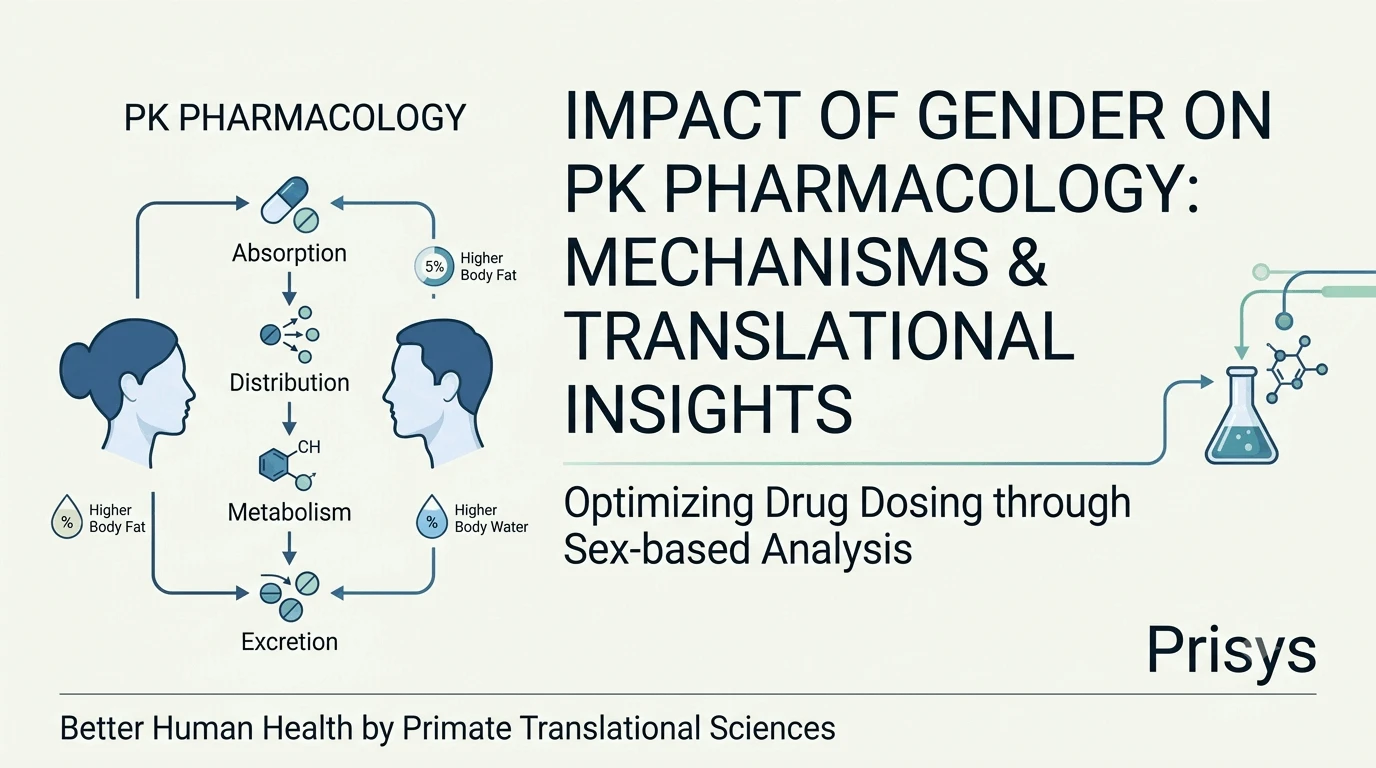
Understanding sex-based physiological differences allows researchers to transition from fixed-dose regimens to precision dosing, mitigating adverse drug reactions (ADRs) that historically affect female populations at disproportionately higher rates.
1. Absorption: Physiological and Gastrointestinal Variations
Sex-specific differences in gastrointestinal (GI) physiology can alter both the rate (Cmax, tmax) and extent (AUC) of oral drug absorption.
- Gastric Motility and Transit Time: Females typically exhibit slower gastric emptying rates and prolonged small intestinal transit times, primarily mediated by progesterone and estrogen effects on smooth muscle contraction. This can delay $t_{max}$ or increase overall absorption for poorly soluble drugs.
- Gastric pH: Basal gastric acid secretion is lower in females, resulting in a higher baseline gastric pH. This difference influences the ionization state, solubility, and dissolution kinetics of weakly acidic or basic compounds.
- Intestinal Transporters: P-glycoprotein (P-gp/ABCB1) expression in the enterocytes shows subtle sex dimorphism. Lower intestinal P-gp expression in females can increase the oral bioavailability of substrate drugs.
2. Distribution: Hydrophilic vs. Lipophilic Partitioning
Drug distribution depends heavily on body composition, organ perfusion, and plasma protein binding.
- Body Composition: Females generally present with a higher percentage of body fat, whereas males have higher total body water and lean body mass.
- Lipophilic Drugs (e.g., Diazepam, Propofol): Exhibit a significantly larger Volume of Distribution (V_d) in females due to increased partitioning into adipose tissue, often to extended terminal elimination half-lives (t1/2).
- Hydrophilic Drugs (e.g., Aminoglycosides, Lithium): Confine primarily to extracellular fluid, resulting in a larger $V_d$ in males and requiring body-weight or lean-mass-adjusted dosing.
- Plasma Protein Binding: Plasma proteins like Alpha-1-acid glycoprotein (AAG) and Albumin bind basic and acidic drugs, respectively. Circulating sex hormones alter protein synthesis and binding site availability; fluctuating estrogen levels can reduce AAG concentration, increasing the free (unbound, pharmacologically active) drug fraction in females.
3. Metabolism: Hepatic Enzyme Activity and Hormonal Regulation
Hepatic phase I (oxidation, reduction, hydrolysis) and phase II (conjugation) clearance pathways exhibit pronounced sexual dimorphism driven by growth hormone secretion patterns and gonadal steroids.
- Cytochrome P450 Isoforms:
- CYP3A4: Females generally display higher hepatic CYP3A4 expression and metabolic activity than males. Substrates primarily cleared by CYP3A4 frequently show higher clearance rates in females.
- CYP1A2 and CYP2E1: Males typically show higher activity for CYP1A2 (influenced by endogenous androgenic regulation) and CYP2E1, to faster clearance of substrates such as caffeine or theophylline.
- CYP2D6 & CYP2C19: Show limited baseline sex dimorphism, though individual exposure remains heavily dictated by genetic polymorphisms and hormonal modulation.
- Phase II Enzymes: Glucuronidation via UDP-glucuronosyltransferases (UGTs, e.g., UGT1A4, UGT2B7) is generally higher in males, driven by androgenic induction.
- Hormonal Fluctuations: Dynamic changes during the menstrual cycle, pregnancy, or oral contraceptive use alter drug clearance through transient enzyme induction or competitive inhibition.
4. Excretion: Renal Elimination Mechanics
Renal clearance (CL_r) is governed by Glomerular Filtration Rate (GFR), tubular secretion, and reabsorption.
- Glomerular Filtration Rate: Males generally possess higher absolute GFR and effective renal plasma flow (ERPF), driven by larger kidney size and lean body mass. When drugs are cleared predominantly via glomerular filtration, absolute renal clearance is typically higher in males unless normalized to body surface area.
- Tubular Transporters: Renal tubular secretion relies on transporter networks including Organic Anion Transporters (OAT1/3), Organic Cation Transporters (OCT2), and P-gp. Estrogen downregulates or upregulates specific transporter densities, creating measurable differences in active tubular secretion rates between sexes.
5. Translational Implications in Drug Development
Failing to account for sex differences early in the discovery pipeline increases clinical attrition rates and dosing inaccuracies.
[ In Vitro / In Vivo Screening ] ➔[ Preclinical SABV Profiling in NHPs ] ➔ (Discovers sex-specific Vd, CL, and half-life)➔[ Optimized First-in-Human Dosing ] ➔ (Reduces Phase I/II safety risks)
Integrating Sex as a Biological Variable (SABV) in preclinical study designs allows sponsor teams to:
1. Identify sex-specific toxicity thresholds and safety margins early.
2. Optimize allometric scaling models for precise First-in-Human (FIH) dose selection.
3. Establish rational stratifications for clinical trial protocols.
Non-Human Primate (NHP) PK Solutions at Prisys Biotech
As a specialized CRO in non-human primate translational research, Prisys Biotech provides high-fidelity NHP pharmacology and PK/PD evaluation platforms. NHPs share near-identical GI physiology, organ mass ratios, homologous CYP enzyme distribution, and hormonal profile characteristics with humans, making them the gold-standard model for evaluating sex-dependent PK behaviors.
Prisys offers comprehensive PK profiling across established translational disease models, including:
- Inflammatory Bowel Disease (IBD) NHP Model
- Metabolic Dysfunction-Associated Steatohepatitis (MASH/NASH) NHP Model
- Acute Hemorrhagic Shock NHP Model
- Renal Fibrosis NHP Model
Our multidisciplinary scientific team supports study design, bioanalysis, and comparative PK/PD modeling tailored to uncover sex-specific exposure patterns and accelerate your candidate towards clinical success.
Partner with Prisys Biotech
To discuss your preclinical PK study design or inquire about our specialized translational NHP models, contact our scientific team today.
Reference
Onuma K, Watanabe M, Sasaki N. Sex as a biological variable in nonclinical studies: Bridging scientific rigor, animal welfare, and regulatory expectations. Animal Model Exp Med. 2026;9(4):698-711. doi:10.1002/ame2.70182
Dalla C, Jaric I, Pavlidi P, et al. Practical solutions for including sex as a biological variable (SABV) in preclinical neuropsychopharmacological research. J Neurosci Methods. 2024;401:110003. doi:10.1016/j.jneumeth.2023.110003