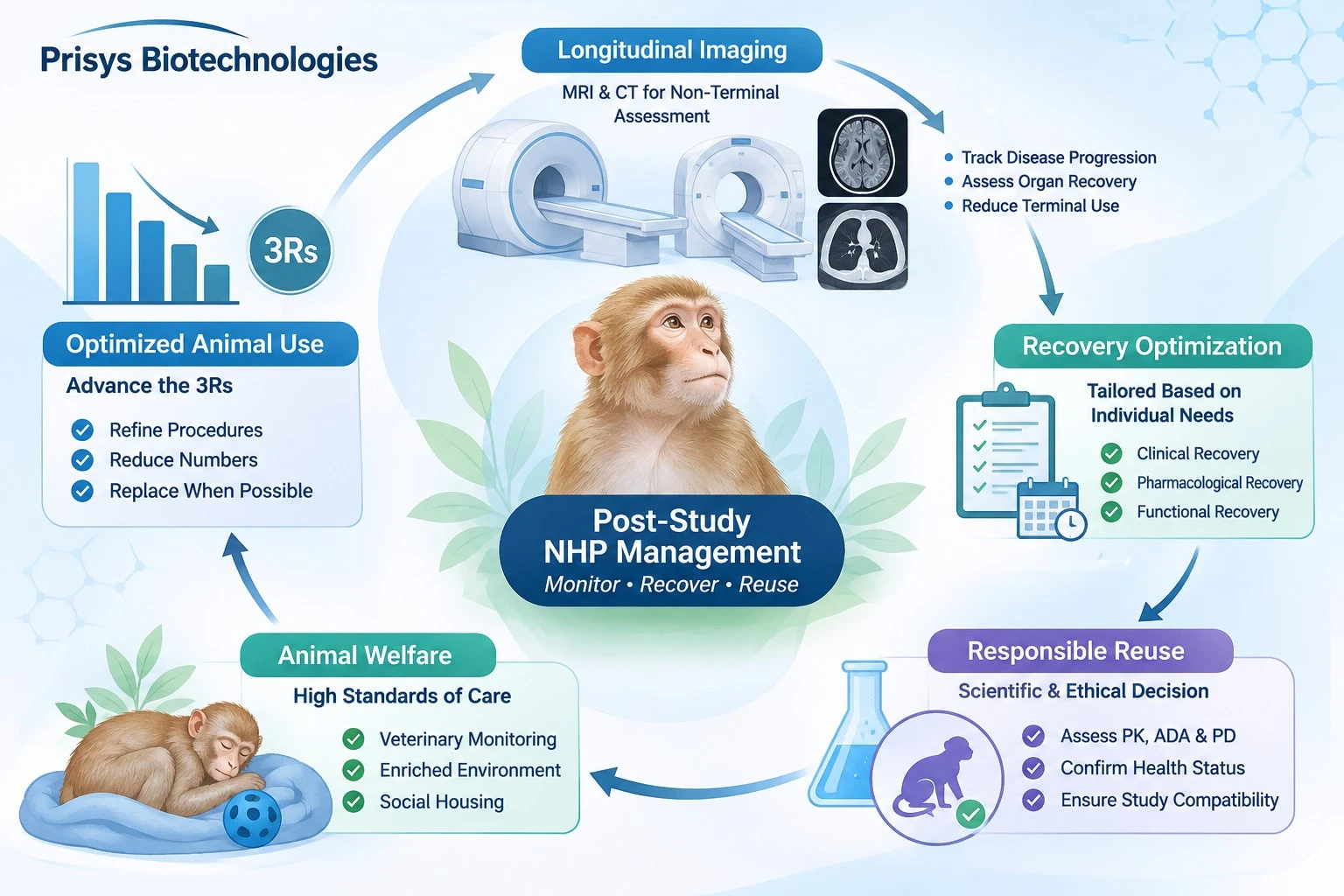
The completion of a preclinical study does not mark the end of an animal's research lifecycle. For non-human primates (NHPs), particularly cynomolgus and rhesus macaques, post-study management covers clinical recovery, long-term health monitoring, animal welfare, data continuity, and the animal's suitability for further research.
These considerations carry particular weight in studies of biologics, monoclonal antibodies (mAbs), gene therapies and complex disease models, where the intervention produces prolonged pharmacological effects, persistent immune responses, or structural changes that outlast the scheduled dosing and observation periods.
For pharmaceutical sponsors and preclinical contract research organizations (CROs), the practical question is whether an animal's physiological condition, immune status and previous experimental exposure are compatible with its next disposition.
A workable post-study strategy answers three questions. Can the animal be monitored without unnecessary terminal procedures? How should the recovery period be set according to actual clinical need? Under what conditions can a previously used NHP enter another study?
Longitudinal imaging, veterinary assessment and biologic-specific washout evaluation together provide a practical framework for these questions while supporting the principles of Replacement, Reduction and Refinement (3Rs).
1. Post-Study Follow-Up: Beyond Routine Clinical Observation
Post-study follow-up extends the original experimental design. It is not an administrative procedure performed after the final study visit.
At study completion, each NHP undergoes an individualized assessment based on its disease model, investigational product, dosing history, surgical interventions and observed adverse effects.
A routine post-study clinical assessment covers body weight, food consumption, general appearance, activity, posture, neurological observations, injection or surgical site evaluation, and relevant hematological and biochemical parameters. Further examinations follow the pharmacological mechanism and potential target-organ effects of the investigational product.
NHPs from CNS studies may need neurological and behavioural assessments. Animals from renal or metabolic disease studies may need urinalysis, renal function measurements or metabolic profiling.
The assessment separates three outcomes:
- Clinical recovery: resolution of procedure-related complications and restoration of general health.
- Pharmacological recovery: sufficient resolution of drug exposure and pharmacodynamic effects for the intended next use.
- Functional recovery: restoration of normal or acceptable physiological and behavioural function.
These outcomes are related and not interchangeable. An animal can appear clinically healthy while retaining measurable drug concentrations, altered immune responses or persistent pharmacological effects.
The decision to close post-study monitoring, or to consider a subsequent study, therefore rests on the animal's complete history rather than on a single clinical examination.
2. Longitudinal MRI and CT: Monitoring Without Unnecessary Terminal Procedures
Longitudinal non-terminal imaging is the main opportunity for improving NHP post-study management.
Preclinical studies often rely on terminal tissue collection to characterise disease progression, organ injury or treatment response. Histopathology remains essential for many research questions, but a design that depends only on terminal endpoints needs separate animal cohorts at each time point.
In selected disease models, MRI and CT follow structural and pathological change within the same animal over time.
MRI for Longitudinal Assessment of Organ and Tissue Changes
MRI allows repeated anatomical and functional assessment without exposure to ionizing radiation.
Depending on the research indication and imaging protocol, MRI informs on:
- Brain structure and lesion development.
- Cerebral perfusion and tissue integrity.
- Renal morphology and structural change.
- Inflammatory lesions and soft-tissue abnormalities.
- Joint, cartilage and musculoskeletal changes.
- Organ-specific disease progression.
In CNS research, serial MRI characterizes lesion evolution, tissue change and treatment-associated response. In renal or inflammatory models, repeated imaging adds information on organ morphology and disease progression.
Each animal can then be compared with its own baseline, which removes part of the variability between animals.
CT for Longitudinal Assessment of Structural Changes
CT suits high-resolution anatomical assessment and quantitative evaluation of structural abnormality: pulmonary lesions and parenchymal change, bone and joint abnormality, and selected vascular or organ-specific evaluations.
In respiratory studies, serial chest CT characterizes the development and resolution of pulmonary abnormalities, and quantitative image analysis provides objective measurements for comparing disease progression and treatment response.
CT delivers ionizing radiation. Scan frequency, cumulative dose, anesthesia requirements and the scientific value of repeated examinations belong in the design of the imaging schedule.
Integrating Imaging With Study Design
The value of longitudinal imaging lies in repeated measurements from the same animal at predefined time points.
|
Study phase
|
Assessment objectives
|
Potential methods
|
|
Baseline
|
Establish individual reference values
|
MRI, CT, clinical assessment
|
|
Active study
|
Monitor disease development and treatment response
|
Serial MRI/CT, clinical endpoints
|
|
End of dosing
|
Evaluate residual pathological changes
|
Imaging, laboratory tests
|
|
Recovery period
|
Assess resolution or persistence of abnormalities
|
Follow-up imaging, veterinary assessment
|
|
Reuse consideration
|
Confirm suitability for a subsequent study
|
Clinical, imaging, PK/PD and immune assessments
|
This design reduces dependence on separate terminal cohorts when imaging endpoints are informative enough for the research question.
Imaging complements histopathology rather than replacing it. Microscopic tissue change, molecular pathology and certain cellular endpoints are not always accessible through conventional MRI or CT, and terminal tissue collection remains appropriate where it is scientifically necessary.
At Prisys Biotech, the in vivo imaging platform includes a 1.5T MRI system and a 40-slice spiral CT system, supporting longitudinal evaluation across CNS, respiratory, renal, cardiovascular and musculoskeletal research applications.
3. Recovery Period Optimization: Balancing Animal Welfare and Research Efficiency
The recovery period after an NHP study follows from the nature and severity of previous procedures, the animal's clinical condition, and the pharmacokinetic and pharmacodynamic characteristics of the investigational product.
A fixed interval applied to every animal rarely works.
For animals that underwent limited procedures, recovery may consist of routine veterinary observation and confirmation that normal physiological and behavioural function has returned.
Animals from neurosurgical interventions, repeated anesthesia, invasive procedures or disease models with persistent organ dysfunction need longer monitoring and a longer recovery period.
The objective is a scientifically justified schedule, not the shortest possible interval between studies.
Individualized Recovery Assessment
Clinical condition: body weight, appetite, hydration, physical examination, hematology, clinical chemistry and relevant organ-function parameters.
Neurological and behavioural function: spontaneous activity, locomotion, posture, coordination and disease-specific behavioural endpoints.
Procedure-related recovery: healing of surgical sites, resolution of inflammation and absence of persistent complications from earlier interventions.
Pharmacological recovery: residual drug exposure and the persistence of relevant pharmacodynamic effects.
Immune status: immune responses, where the previous study involved biologics, immunomodulators or other interventions capable of altering immune function.
Not every assessment is needed for every study. The monitoring plan should match the potential risks and the intended future use of the animal.
An Illustrative Example: Reducing NHP Requirements in a Monoclonal Antibody Study
mAb study designs often allocate separate cohorts to different observation periods, terminal tissue assessment and recovery evaluation.
When serial imaging and other validated longitudinal endpoints answer the same research questions, that allocation can be reconsidered.
In one internal mAb study-planning example, an optimized allocation reduced the planned NHP requirement from 48 to 26 animals, a reduction of approximately 45.8%.
The principle is to test whether every planned cohort is scientifically necessary.
Longitudinal imaging, repeated clinical assessment and follow-up measurements can supply selected endpoints from the same animals instead of adding animals at each observation time point.
That optimization supports the Reduction principle while keeping the scientific objectives of the study intact.
Number reduction cannot come at the expense of statistical validity, endpoint reliability or animal welfare. The design needs an appropriate scientific rationale, and the proposed allocation goes through ethical review before implementation.
The 48-to-26 example is a study-specific planning outcome, not a generalizable reduction rate for mAb studies.
4. Reuse of Previously Studied NHPs: Scientific and Ethical Considerations
Reuse of previously studied NHPs is a routine part of preclinical research and a frequently misjudged one.
A previously used animal is not automatically suitable for another study because the original experimental procedures have ended.
Animals exposed to biologics may retain residual drug concentrations, anti-drug antibodies (ADA), altered target expression or persistent pharmacodynamic effects, and each of these influences the interpretation of later results.
Suitability of a non-naive NHP is therefore judged on animal welfare and on scientific grounds together.
4.1 Clinical Eligibility
The first requirement is acceptable general health and welfare.
The veterinary team reviews the complete medical and experimental history:
- Previous disease models and experimental interventions.
- Surgical procedures and anesthesia exposure.
- Adverse events and treatment history.
- Hematological and biochemical abnormalities.
- Persistent neurological, respiratory or organ-specific changes.
- Behavioural condition and housing compatibility.
An animal with unresolved complications, persistent organ dysfunction or an unacceptable cumulative procedural burden is not eligible merely because a previous study has ended.
4.2 Pharmacological Eligibility
For animals previously exposed to mAbs or other biologics, pharmacological washout needs more than a predetermined number of days.
Residual drug exposure. Circulating concentrations are measured with an appropriate bioanalytical method. The acceptable residual concentration follows from the mechanism of action, assay sensitivity and the objectives of the next study.
Anti-drug antibodies. ADA can alter drug clearance, exposure, biological activity and assay interpretation, so ADA assessment and, where relevant, neutralizing antibody assessment may be required.
Pharmacodynamic recovery. Downstream biological effects can outlast measurable exposure: receptor occupancy, target modulation, immune-cell change or sustained cytokine alteration.
Target and pathway recovery. Where the next study involves the same or a related pathway, check whether the previous intervention altered target expression, target availability or pathway responsiveness.
These factors matter most for long-acting antibodies, Fc-engineered biologics, immune-modulating agents and molecules with target-mediated disposition.
A pharmacokinetic washout period alone cannot establish that an animal is suitable for another pharmacological study.
5. A Practical Washout and Reuse SOP for Biologic-Exposed NHPs
A structured decision procedure improves consistency when non-naive NHPs are evaluated after biologic studies. The framework below is a study-specific operational approach, not a universal washout standard and not a substitute for institutional animal welfare review.
Step 1. Review the Previous Study History
Compile a complete record of previous exposure: investigational product, dose, route of administration, dosing frequency, final administration date, adverse events, PK profile, ADA results and pharmacodynamic endpoints. Document previous surgery, tissue sampling, imaging exposure and cumulative anesthesia.
Step 2. Evaluate Residual Drug Exposure
Quantify residual circulating drug with a validated or otherwise fit-for-purpose bioanalytical method on an appropriate post-study sample.
For mAbs, consider terminal elimination characteristics, target-mediated drug disposition and differences in exposure between individual animals.
Set the decision threshold according to the objectives of the next study. A concentration acceptable for an unrelated pharmacological study can still interfere with a study on the same biological pathway.
Step 3. Assess ADA and Immune Recovery
For biologic-exposed animals, ADA evaluation informs on immunogenicity and residual immune response. Depending on the product and the study objectives, assessments include:
- Binding ADA.
- Neutralizing antibodies, where relevant.
- Relevant immune-cell populations.
- Selected cytokines or immune-related biomarkers.
- Mechanism-specific immune endpoints.
Read ADA alongside PK and PD. ADA does not automatically disqualify an animal from all future studies, but it can introduce confounding in studies involving the same molecule or immunological pathway.
Step 4. Confirm Pharmacodynamic Recovery
Establish whether the biological effects of the previous product have resolved, using receptor occupancy, target expression, circulating biomarkers, immune-cell profiles or disease-specific functional measurements.
Define the criteria before the animal is assigned to the next study. The required degree of recovery depends on the intended study: complete return to baseline is not necessary for every unrelated application, but residual effects cannot be allowed to compromise interpretation.
Step 5. Conduct Veterinary Reassessment
A comprehensive veterinary examination confirms recovery from previous procedures and suitability for the proposed study: general clinical condition, organ function, behaviour, surgical recovery and cumulative lifetime procedural history. Additional MRI or CT follows up organs or tissues that need structural assessment.
Step 6. Complete Ethical and Scientific Review
The final decision integrates the pharmacological evaluation, the veterinary assessment, previous procedural severity and the proposed study design. The reuse proposal needs scientific justification and review through the applicable institutional animal care and ethical approval process.
A negative drug concentration result or the completion of a nominal washout period is not sufficient grounds for reuse on its own.
Suggested Decision Framework
|
Assessment domain
|
Key question
|
Decision consideration
|
|
Clinical health
|
Has the animal recovered from previous procedures?
|
Veterinary eligibility
|
|
Drug exposure
|
Is residual investigational product sufficiently low?
|
Study-specific PK criteria
|
|
Immunogenicity
|
Could ADA affect the next study?
|
Immunological compatibility
|
|
Pharmacodynamics
|
Have relevant biological effects resolved?
|
PD and target recovery
|
|
Organ function
|
Are previous pathological changes resolved or stable?
|
Clinical and imaging findings
|
|
Study compatibility
|
Could previous exposure confound the next experiment?
|
Scientific suitability
|
|
Ethical approval
|
Is reuse justified and approved?
|
IACUC and applicable requirements
|
The framework is most relevant to reuse decisions after mAb, cytokine-targeting biologic and other immune-modulating studies.
6. AAALAC Accreditation and Animal Welfare During the Recovery Period
Animal welfare stays central through the whole research lifecycle, including the period after experimental procedures have ended.
AAALAC International accreditation provides a framework for evaluating institutional animal care and use programs. It is an institutional quality and welfare standard. It does not authorise animal reuse, and it does not replace individual veterinary and ethical assessment.
Recovery management in an NHP facility goes beyond resolving clinical abnormalities.
Veterinary Monitoring and Post-Procedural Care
Animals recovering from surgery, repeated anesthesia or other invasive procedures need dedicated observation and supportive care. Where clinically indicated, monitoring covers pain assessment, wound evaluation, hydration, nutritional status and relevant physiological parameters. Animals with more complex recovery needs may be placed temporarily in dedicated recovery or intensive-care facilities.
Social Housing and Environmental Enrichment
NHPs are highly social. Social interaction, environmental enrichment and the opportunity to express species-typical behaviour are part of their long-term welfare.
After a study, animals return to compatible social housing when clinically and scientifically appropriate. Where separation was necessary for medical or experimental reasons, reintroduction is assessed individually and, where appropriate, carried out gradually under veterinary and animal-care supervision.
Enrichment includes foraging opportunities, manipulable objects, feeding enrichment and other activities that encourage natural behaviour. The recovery environment also minimises unnecessary handling and disturbance.
The Relationship Between Welfare and Data Quality
Animal welfare and scientific reliability are connected. Persistent stress, pain, abnormal activity or unresolved disease influence physiological and behavioural endpoints, and those effects introduce variability into later pharmacological assessments.
A well-managed recovery period protects the animal and establishes a more reliable physiological baseline for any scientifically justified future research.
7. How Longitudinal Imaging Supports More Informed Post-Study Decisions
Longitudinal imaging adds a layer of information when the recovery and future suitability of previously studied NHPs are assessed.
Animals from pulmonary disease studies may undergo follow-up CT to show whether previously observed pulmonary abnormalities have resolved or persist. MRI provides structural information after CNS interventions or organ-specific procedures.
These assessments separate animals that have returned to an acceptable physiological condition from those that need continued observation or further clinical investigation.
Normal imaging does not establish pharmacological or immunological recovery on its own. Imaging is read alongside clinical examination, laboratory measurements and relevant PK/PD data.
At Prisys Biotech, MRI, CT, clinical assessment and NHP pharmacology are integrated, which allows non-terminal follow-up endpoints in selected preclinical programs. The imaging infrastructure includes a 1.5T MRI system and a 40-slice CT system, with capabilities for neurological, pulmonary, renal and other organ-specific assessment.
8. Planning Post-Study Management Before the Study Begins
A post-study management strategy belongs in the original study-design phase, not in the weeks after the final dosing visit.
Sponsors can settle several questions before study initiation. What is the intended disposition of the animals? Which endpoints require terminal tissue collection, and which can be evaluated longitudinally? What clinical or pharmacological criteria define recovery? Will the investigational product produce prolonged exposure or immunological effects? Could a previously used animal be scientifically suitable for an unrelated future study?
Early answers improve animal allocation, clarify recovery requirements and reduce unnecessary procedures.
For biologic studies, post-study PK sampling, ADA testing and mechanism-specific PD assessment can enter the original protocol when future animal disposition is relevant. That gives a systematic basis for evaluating reuse instead of relying on incomplete retrospective information.
Conclusion: Integrating Animal Welfare, Longitudinal Science, and Responsible NHP Utilization
Post-study NHP management is part of responsible preclinical research. It connects clinical recovery, pharmacological assessment, animal welfare and future research planning.
Longitudinal MRI and CT provide non-terminal information on disease progression and structural recovery, and they can reduce dependence on separate terminal cohorts where appropriate. Individualized recovery assessment keeps animals out of unnecessary procedures and premature reassignment. For biologic-exposed NHPs, structured evaluation of residual drug exposure, ADA and pharmacodynamic recovery comes before any consideration of subsequent research.
At Prisys Biotech, post-study management runs on an AAALAC-accredited NHP research facility, veterinary and clinical capability, and an imaging platform that includes MRI and CT. These capabilities allow longitudinal assessment and individualized recovery planning to enter NHP pharmacology study designs.
For sponsors developing monoclonal antibodies, other biologics and advanced therapeutic candidates, considering the full research lifecycle at the design stage improves planning, supports the 3Rs and makes better use of NHP research resources.
Frequently asked questions
Q: What happens to NHPs after a preclinical study is completed?
A: After a study, NHPs undergo clinical and veterinary assessment based on their previous procedures, disease models and investigational product exposure. Depending on health status and study history, an animal may enter a recovery period, continue under long-term observation, be considered for an ethically approved subsequent study, or follow another appropriate disposition pathway.
Q: Can MRI and CT replace terminal tissue collection in NHP studies?
A: Not universally. MRI and CT provide longitudinal information on organ structure, lesions and selected disease-related changes without requiring terminal tissue collection at every time point. Histopathology and molecular tissue analysis remain necessary when microscopic or cellular endpoints are required, so imaging is used as a complementary method where it is scientifically appropriate.
Q: How long should the recovery period be before an NHP can enter another study?
A: No single recovery period applies to all NHP studies. The interval depends on previous procedural severity, clinical recovery, organ function, residual drug exposure and the requirements of the proposed subsequent study. Veterinary assessment and applicable ethical approval come before any reuse.
Q: How is washout evaluated before reusing NHPs exposed to monoclonal antibodies?
A: A biologic washout assessment covers residual circulating drug concentrations, anti-drug antibodies, pharmacodynamic effects and the recovery of relevant biological pathways. A fixed number of days or elimination half-lives alone may not establish suitability for another study. The criteria should be tailored to the molecule and to the intended subsequent research.
Q: Does AAALAC accreditation permit the reuse of previously studied NHPs?
A: No. AAALAC accreditation evaluates institutional animal care and use programs. It does not independently authorise the reuse of individual animals. Reuse requires a scientifically justified assessment of the animal's health, previous procedural history and proposed future study, plus compliance with applicable institutional and regulatory requirements.
Q: How can longitudinal imaging contribute to the 3Rs in NHP research?
A: Longitudinal imaging supports the Reduction principle by enabling repeated measurements in the same animal, which can reduce the need for separate terminal cohorts. It also supports Refinement through non-terminal assessment options. Anesthesia, handling, CT radiation exposure and other procedural burdens still belong in the design of the imaging schedule.
Q: Can NHPs previously exposed to biologics be used in unrelated studies?
A: Potentially, but eligibility is determined individually. Even when circulating drug concentrations have declined, previous biologic exposure may leave persistent immunological or pharmacodynamic effects. The relevance of those effects to the subsequent study, together with clinical recovery and veterinary assessment, determines suitability.