Non-human primates (NHPs) play a critical role in modern drug development because of their close genetic, physiological, and immunological similarities to humans. Among the various NHP species used in biomedical research, cynomolgus monkeys (Macaca fascicularis) and rhesus monkeys (Macaca mulatta) are the two most widely utilized.
Although both species belong to the macaque family and share many biological characteristics, important differences exist in their anatomy, genetics, immune responses, behavior, and research applications. Understanding these distinctions is essential when selecting the most appropriate translational model for efficacy, safety, pharmacokinetic (PK), pharmacodynamic (PD), and biomarker studies.
Taxonomy and Geographic Distribution
Cynomolgus monkeys are native to Southeast Asia, including Indonesia, Malaysia, the Philippines, Thailand, and Vietnam. Due to their adaptability, they inhabit coastal regions, mangrove forests, and tropical woodland environments.
Rhesus monkeys have a broader natural distribution extending across South and East Asia, particularly India and China. They can adapt to diverse ecological environments ranging from tropical forests to mountainous regions.
The distinct evolutionary histories of these species have contributed to measurable differences in genetics, physiology, and immune system characteristics relevant to translational research.
Physical Characteristics
While both species are medium-sized macaques, several morphological differences are commonly observed.
| Characteristic | Cynomolgus Monkey | Rhesus Monkey |
|---|---|---|
| Adult body weight | Approximately 3–8 kg | Approximately 5–12 kg |
| Body structure | Slender and lighter | More robust and muscular |
| Tail length | Long tail, often approaching body length | Significantly shorter tail |
| Facial appearance | Narrower face | Broader facial structure |
| Geographic origin | Southeast Asia | South and East Asia |
The smaller body size of cynomolgus monkeys often results in reduced compound requirements during preclinical studies, which can be advantageous for early-stage drug development programs involving expensive biologics or limited drug supply.
Genetic and Immunological Differences
Both species share a high degree of genetic homology with humans. However, notable differences exist in genes associated with immune regulation, inflammatory pathways, and drug metabolism.
These differences can influence:
- Pharmacokinetic profiles
- Immunogenicity assessment
- Vaccine responses
- Cytokine signaling
- Biomarker expression
For biologics, antibody therapeutics, and immune-modulating agents, species-specific target cross-reactivity often becomes an important consideration during model selection.
Researchers therefore frequently evaluate target sequence homology, receptor binding characteristics, and immune pathway conservation before initiating NHP studies.
Behavioral Characteristics
Behavioral differences between the two species may also affect study execution and data quality.
Cynomolgus monkeys are generally considered more socially tolerant and easier to manage in group housing environments. Their behavioral stability often facilitates long-term pharmacology studies and repeated experimental procedures.
Rhesus monkeys typically exhibit stronger social hierarchies and may demonstrate higher levels of territorial or aggressive behavior. While these characteristics can increase management complexity, they may also provide advantages for certain neuroscience and behavioral research applications.
Behavioral considerations become particularly important in studies involving:
- Neurodegenerative diseases
- Cognitive function assessments
- Pain research
- Psychiatric disease models
- Longitudinal behavioral monitoring
Differences in Drug Development Applications
Both cynomolgus and rhesus monkeys contribute significantly to translational research; however, their usage patterns differ across therapeutic areas.
Cynomolgus Monkeys
Cynomolgus monkeys have become the predominant NHP species in global pharmaceutical development and are frequently used for:
- Safety pharmacology studies
- Toxicology studies
- Monoclonal antibody development
- Gene and cell therapy evaluation
- PK/PD studies
- Immunology and inflammation research
- Metabolic disease models
Their widespread availability, well-characterized biology, and extensive historical control data make them a preferred species for regulatory studies.
Rhesus Monkeys
Rhesus monkeys remain highly valuable for:
- Neuroscience research
- Cognitive function studies
- Infectious disease research
- Vaccine development
- Reproductive biology
- Behavioral pharmacology
Because of their extensive use in neuroscience and infectious disease research, substantial reference data have been accumulated for these applications.
Considerations for Translational Research
Selecting between cynomolgus and rhesus monkeys should be based on scientific objectives rather than species familiarity alone.
Key factors include:
- Target expression and cross-reactivity
- Disease biology
- Pharmacokinetic characteristics
- Historical regulatory precedent
- Availability of validated disease models
- Biomarker applicability
- Imaging compatibility
- Behavioral endpoints
In many modern drug development programs, cynomolgus monkeys are selected because they offer a strong balance between translational relevance, regulatory acceptance, and operational feasibility.
How Prisys Supports NHP Translational Research
Prisys Biotech provides integrated non-human primate (which includes cynomolgus monkeys (Macaca fascicularis) and rhesus monkeys (Macaca mulatta)) research services centered primarily on cynomolgus monkey models. Supported by AAALAC-accredited facilities, advanced clinical imaging platforms, MRI-guided CNS delivery capabilities, and AI-based behavioral analysis systems, Prisys enables comprehensive translational evaluation from early pharmacology studies through IND-enabling research.
Our scientific platforms support multiple therapeutic areas, including:
- CNS and neurological diseases
- Respiratory disorders
- Immunology and inflammation
- Cardiometabolic diseases
- Nephrology
- Ophthalmology
- Fibrosis research
- Hematology and thrombosis
By combining well-characterized NHP disease models with clinical-equivalent imaging and biomarker assessments, researchers can generate data with greater relevance to human clinical outcomes.
Conclusion
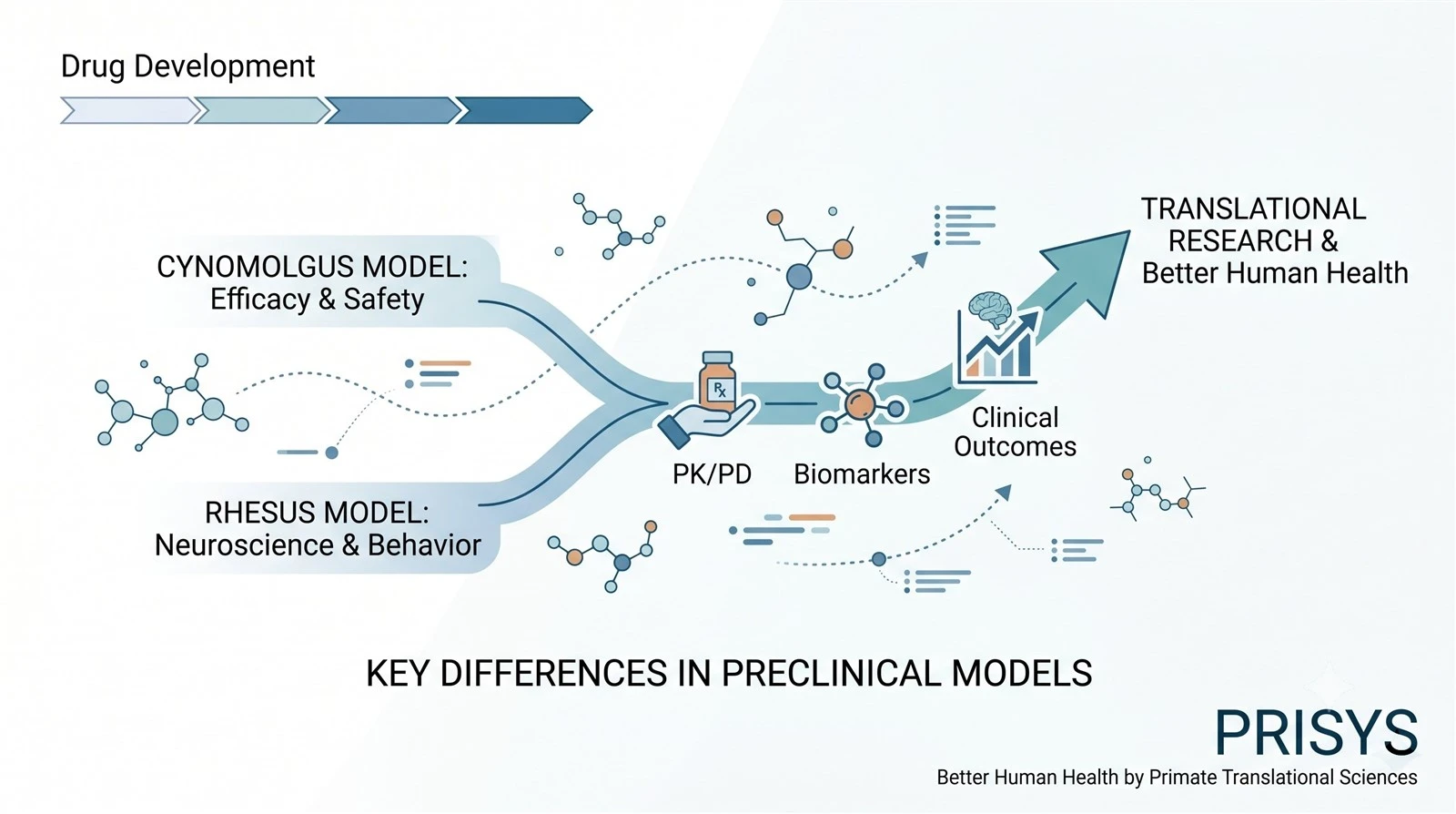
Both cynomolgus monkeys and rhesus monkeys are valuable translational research models, but they serve different scientific purposes. Cynomolgus monkeys are generally preferred for toxicology, PK/PD, biologics, and translational pharmacology studies, whereas rhesus monkeys continue to provide important value in neuroscience, infectious disease, and behavioral research.
Careful evaluation of biological relevance, study objectives, and translational requirements is essential when selecting the optimal NHP model for a drug development program.
FAQ
Q: Why are cynomolgus monkeys commonly used in pharmaceutical development?
A: Cynomolgus monkeys offer strong translational relevance, broad regulatory acceptance, extensive historical control data, and wide availability, making them one of the most frequently used NHP species in preclinical research.
Q: What is the major difference between cynomolgus and rhesus monkeys in research?
A: The most important differences involve genetics, immune responses, behavior, and study applications. These factors can influence model selection depending on therapeutic area and research objectives.
Q: Which species is preferred for monoclonal antibody development?
A: Cynomolgus monkeys are often preferred because many therapeutic antibodies demonstrate target cross-reactivity with cynomolgus antigens, enabling meaningful safety and pharmacology evaluations.
Q: Are rhesus monkeys better for neuroscience research?
A: Rhesus monkeys have historically been widely used in neuroscience and cognitive research due to their well-characterized neurobiology and behavioral complexity.
Q: How should researchers choose between cynomolgus and rhesus monkeys?
A: Selection should be based on target biology, disease relevance, pharmacology requirements, biomarker strategy, and regulatory considerations rather than species availability alone.